Canon EOS Rebel T5 Review: Entry-Level Visuals Examined
The Canon EOS Rebel T5 is an entry-level digital single-lens reflex camera engineered to introduce aspiring creators to interchangeable optics and manual exposure control. In this Canon EOS Rebel T5 review, our evaluation shows that the camera delivers dependable imaging fundamentals, straightforward ergonomic handling, and a predictable learning curve for still photography, even though its…
10 min read
As Amazon Associates, we earn from qualifying purchases. This means we may receive a small commission at no extra cost to you if you click through and make a purchase.
The Canon EOS Rebel T5 is an entry-level digital single-lens reflex camera engineered to introduce aspiring creators to interchangeable optics and manual exposure control. In this Canon EOS Rebel T5 review, our evaluation shows that the camera delivers dependable imaging fundamentals, straightforward ergonomic handling, and a predictable learning curve for still photography, even though its operational speed and video feature set clearly reflect an earlier hardware generation.
This setup is well suited for beginners learning manual photography, family documentarians who want more creative flexibility than a smartphone provides, and hobbyists eager to experiment with telephoto framing right out of the box. However, high-speed sports photographers, dedicated content creators needing modern autofocus tracking, and live streamers looking for plug-and-play webcam functionality will want to look at more modern alternatives.
Sensor Performance and Image Clarity
At the heart of the imaging architecture, the Canon Rebel T5 sensor specs center around an 18-megapixel APS-C CMOS sensor paired with Canon’s DIGIC 4 image processor. This sensor size provides an immediate advantage over point-and-shoot cameras like the canon elph 360 hs by gathering significantly more ambient light and delivering natural background separation. When working in bright daylight or controlled studio illumination, the sensor produces clean detail, accurate skin tones, and rich color reproduction across its native aspect ratio.
The DIGIC 4 engine manages internal throughput, rendering both standard JPEG images and unprocessed RAW files. For creators who like to edit their exposures manually, the RAW capture capability provides ample room to balance highlights and lift shadows in landscape or portrait framing. The expanded minimum sensitivity of ISO 100 ensures that outdoor portraits taken at wide apertures retain crisp texture without unnecessary noise. When ambient light drops, the camera relies on its 63-zone dual-layer metering system to balance evaluative, center-weighted, or spot-style readings across the frame.
Long exposure enthusiasts will appreciate that the shutter mechanism supports speeds up to 30 seconds, enabling night scenes, light trails, and low-light architecture shots when paired with a stable tripod. While modern sensors push noise suppression into extreme ISO ranges, the hardware here performs best when kept within moderate sensitivity thresholds. Pushing exposure boundaries in dimly lit rooms will reveal luminance noise earlier than modern flagship sensors, making proper scene lighting an essential part of the shooting process.
Dual-Lens Kit Capabilities
One of the primary selling points of this package is the inclusion of the Canon Rebel T5 two lens bundle, which pairs the camera body with two distinct focal ranges to cover everyday shooting scenarios. The kit includes the Canon T5 EF-S 18-55mm IS II standard zoom alongside the EF 75-300mm f/4-5.6 III telephoto zoom. Having access to both pieces of glass immediately expands your creative range without requiring separate optical investments right away.
The standard 18-55mm lens serves as the general workhorse, offering a versatile wide-angle to moderate portrait perspective with a maximum aperture of f/3.5 at the wide end. This lens features built-in optical image stabilization, which counteracts involuntary hand tremors and assists in keeping hand-held shots sharp at slower shutter speeds. While dedicated pocket shooters such as the canon sx620 hs rely on compact integrated optics, the physical zoom ring and mechanical balance of an EF-S lens offer a much more tactile and deliberate shooting experience.
Switching over to the EF 75-300mm telephoto lens shifts the shooting dynamic toward distant subjects, making it useful for backyard wildlife, daytime field sports, and compressed scenic vistas. However, users should note that the listing does not specify optical stabilization for this secondary 75-300mm lens. Because telephoto focal lengths magnify camera shake, maintaining high shutter speeds or utilizing physical bracing becomes important when zooming all the way to 300mm.
Video Capture and Media Creation
Moving beyond still imagery, the camera includes an EOS 1080p full HD movie mode designed for recording video clips of family events, creative projects, and basic digital media. Recording video on a large APS-C sensor gives footage a distinct cinematic aesthetic compared to mobile devices, with genuine optical depth of field. The Canon Rebel T5 1080p video recording provides a dependable baseline for creators producing static interview frames or basic hobby videos under good lighting.
When assessing the Canon Rebel T5 for streaming setups or gaming broadcasts, buyers must consider the technical constraints of early-generation DSLR hardware. The listing does not specify clean HDMI output capabilities, direct USB webcam utility compatibility, or external microphone input jacks. Creators who want to route their video feed into live streaming software generally face the challenge of on-screen display overlays or strict runtime sleep limits inherent to classic entry-level DSLRs. While high-end compact cameras like the canon sx740 hs camera integrate modern digital streaming conventions, this DSLR was engineered primarily as a traditional visual capture tool rather than a broadcast feed.
Audio recording is handled via internal hardware, and autofocus during video capture relies on contrast-based Live View tracking. Because the DIGIC 4 processor was not designed for rapid movie servo autofocus, manual focus adjustment using the lens ring is generally the best way to keep moving subjects sharp. For aspiring filmmakers, this limitation can actually serve as a practical training ground for mastering manual focus pull techniques.
Ergonomics, Controls, and Everyday Operation
Weighing in at 15.36 ounces for the body alone, the camera maintains a rugged yet lightweight form factor that feels substantial in the hands without causing fatigue during extended walks. The deep handgrip provides secure handling whether shooting one-handed or balancing the longer telephoto lens. Physical buttons and mode dials are laid out logically, allowing quick access to critical shooting parameters without getting lost in complicated software submenus.
Framing and review are handled through either the optical viewfinder or the 3-inch LCD TFT color monitor. The optical viewfinder delivers an uninterrupted, lag-free view of your subject, which helps preserve battery performance over a full afternoon of shooting. The rear 3-inch monitor provides a bright, spacious surface for evaluating focus accuracy, checking exposure histograms, and navigating the on-screen Feature Guide. However, the rear panel is fixed in place, so shooters who frequently compose high-angle overhead shots or low-to-the-ground macro perspectives must adjust their body positioning accordingly.
The operational framework of this Canon EOS Rebel T5 beginner DSLR emphasizes accessibility through several automated shooting modes. The Scene Intelligent Auto mode analyzes scene brightness, color balance, and subject movement to select optimal parameters automatically. For users wanting creative assistance, built-in Creative Auto, Portrait, Landscape, and Basic+ functions simplify stylistic choices. Advanced shooters can instantly switch the dial over to Program AE, Shutter-Priority AE, Aperture-Priority AE, or full Manual Exposure to take complete control of the exposure triangle. Continuous burst shooting operates at up to 3 frames per second, which accommodates steady action but requires careful timing when tracking erratic motion.
Canon EOS Rebel T5 Pros and Cons
Pros
- Dual-lens bundle covers wide-angle to 300mm telephoto
- 18MP APS-C sensor delivers clean RAW images
- Optical image stabilization on standard 18-55mm lens
- Large 3-inch LCD monitor with built-in feature guide
- Broad compatibility with Canon EF and EF-S lenses
Cons
- Continuous burst rate tops out at 3fps
- Older DIGIC 4 image processor limits operating speed
- Fixed rear display lacks articulation and touch controls
Check Canon EOS Rebel T5 on Amazon
Who Should Buy the Canon EOS Rebel T5
Deciding whether the Canon EOS Rebel T5 specs align with your visual goals comes down to how you prioritize physical ergonomics and optical variety over high-speed processing. If you want a dedicated platform to learn manual exposure while having focal reach from 18mm all the way to 300mm, this kit delivers solid mechanical tools. When asking is Canon camera T5 worth it, the answer depends entirely on whether your focus lies in still photography education or modern fast-paced multimedia production.
Buy It If
- You want a complete dual-lens kit that covers both wide landscapes and distant telephoto subjects right away.
- You are a photography student or beginner seeking physical dials to learn manual exposure, aperture control, and shutter mechanics.
- You prioritize RAW file capture on an APS-C sensor to practice photo editing and color grading.
- You want access to the vast ecosystem of interchangeable Canon EF and EF-S lenses for future expansion.
Skip It If
- You require high-speed continuous burst rates for fast-moving sports, birds in flight, or dynamic action scenes.
- Your primary workflow revolves around modern live streaming, vlogging, or plug-and-play desktop webcam operation.
- You need a fully articulating touchscreen display for low-angle framing or self-recorded video production.
Canon EOS Rebel T5 Alternatives Worth a Look
Before making a final commitment, comparing this setup against other visual devices on the market reveals how different form factors and technologies address modern creative needs.
8K Digital Cameras for Photography
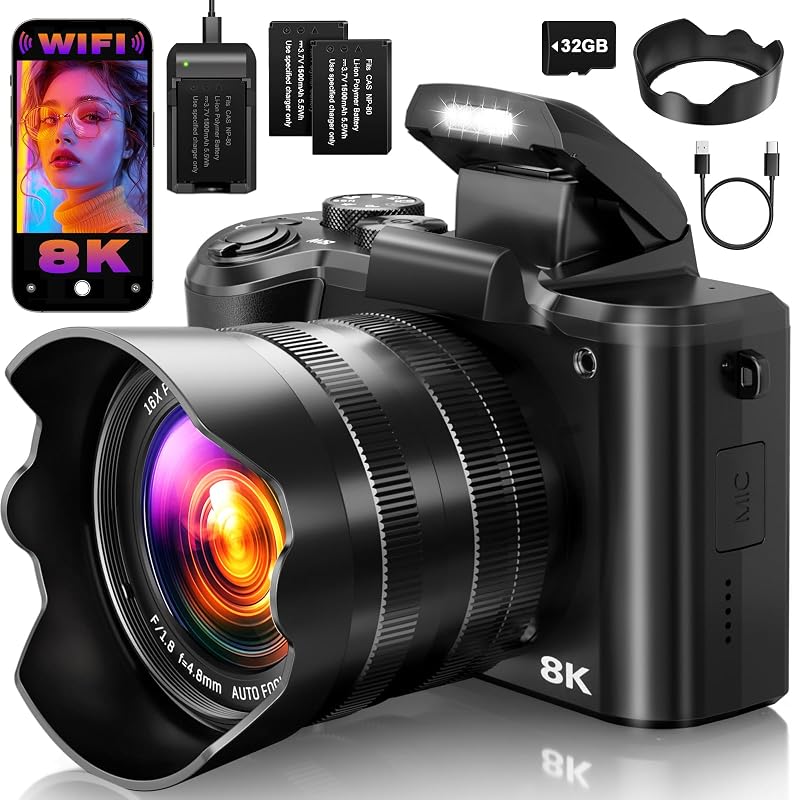
The 8K Digital Cameras for Photography presents a completely different approach geared toward contemporary video-centric social creators. With its listed 88MP resolution claim, dual-lens design, 16X digital zoom, touch screen, WiFi integration, and included charging stand with two batteries, it targets YouTube creators who want an all-in-one vlog setup. Shooters seeking traditional optical glass, mechanical shutters, and interchangeable lens versatility will stick with the DSLR, while those focused on digital convenience and touch controls might lean toward this unit.
1080p Full HD Video

The 1080p Full HD Video bridge camera, represented by the Kodak PIXPRO AZ528, offers an all-in-one alternative with a fixed 52x optical zoom lens and a 24mm wide-angle perspective. It features a 16MP sensor, optical image stabilization, 6fps burst shooting, and built-in Wi-Fi in a bridge-style body. Readers who want tremendous telephoto reach without ever swapping physical lenses or carrying a dedicated camera bag may prefer the convenience of this bridge configuration over an interchangeable DSLR system.
Nikon D7500 20.9MP DSLR Camera

The Nikon D7500 20.9MP DSLR Camera with its AF-S DX NIKKOR 18-140mm f/3.5-5.6G ED VR lens represents an enthusiast-tier DSLR alternative for photographers demanding higher operational speed and expanded physical durability. With a 20.9-megapixel sensor and a single versatile zoom lens, it caters to creators who want deeper buffer performance and more advanced semi-professional controls than what a beginner-oriented Rebel body provides.
Final Verdict
The Canon EOS Rebel T5 holds its ground as a practical, no-nonsense photographic instrument for anyone learning the fundamentals of the craft. Its combination of an 18-megapixel APS-C sensor, dual zoom lenses covering 18mm to 300mm, and dependable physical controls gives new photographers the exact tactile experience needed to understand manual exposure. While more compact options like the canon powershot elph 350 hs prioritize pocket mobility, this DSLR provides the authentic grip, optical viewfinder, and glass adaptability that traditional photography enthusiasts value.
At the same time, prospective buyers must enter with realistic expectations regarding its video and action credentials. The 3 fps continuous shooting speed, older DIGIC 4 processing hardware, and absence of modern broadcast connectivity mean it is not designed to serve as a high-speed sports rig or automated streaming camera. If your creative path is centered on learning still photography, exploring focal lengths from landscape to wildlife, and mastering exposure theory, this classic setup remains an educational and capable companion.
FAQ
What lenses can I use with the Canon EOS Rebel T5?
The camera body features native compatibility with both Canon EF and Canon EF-S mount lenses. This allows you to attach dozens of standard zooms, telephotos, macro optics, and wide-aperture prime lenses across the extensive Canon lens catalog.
Does the Canon EOS Rebel T5 shoot in RAW image format?
Yes, the camera supports both standard JPEG compression and uncompressed RAW file formats. Capturing images in RAW gives you maximum dynamic range flexibility when adjusting white balance, exposure levels, and shadow details in photo editing software.
Can I use the Canon Rebel T5 as a live streaming camera?
While the camera records EOS 1080p full HD video internally, the listing does not specify native webcam software support or clean HDMI output. Using it for modern live streaming typically requires external capture cards and workarounds to manage on-screen display data and auto-off timers.
How fast is the continuous burst shooting on the Canon T5?
The camera offers continuous shooting speeds of up to 3 frames per second. This rate works well for capturing family portraits, walking subjects, and slow action, but it requires precise anticipation if you are attempting to freeze fast-paced athletic motion.
Does the rear LCD screen swivel or support touch controls?
The 3-inch TFT liquid-crystal monitor is fixed directly into the rear casing and does not offer articulation or touch-based navigation. All menu selections, shooting adjustments, and playback controls are operated via the physical buttons and cross keys on the camera body.
How these reviews are put together
- 203reviews published
- 2,271products with a buyer rating
- 2,222products with listed features
- 87brands covered
Every number, star and price on this site is read from the Amazon product listing. We do not run lab tests of our own, so a score here is the average rating left by buyers, not a verdict from a test bench. Prices change without notice; check the listing before buying.


