Make-A-Fort Minecraft Explorer Kit: Bringing Block Building to Life
The Make-A-Fort Minecraft Explorer Kit brings the beloved voxel-building mechanics of the digital screen into physical living spaces through life-sized building panels, interlocking foam joints, and reinforcement braces. Designed to let kids craft walk-in play spaces without relying on makeshift couch cushions or scrap shipping containers, this make a fort explorer kit review finds that…
9 min read
As Amazon Associates, we earn from qualifying purchases. This means we may receive a small commission at no extra cost to you if you click through and make a purchase.
The Make-A-Fort Minecraft Explorer Kit brings the beloved voxel-building mechanics of the digital screen into physical living spaces through life-sized building panels, interlocking foam joints, and reinforcement braces. Designed to let kids craft walk-in play spaces without relying on makeshift couch cushions or scrap shipping containers, this make a fort explorer kit review finds that the set successfully channels sandbox creativity into sturdy, room-scale architecture that looks and feels remarkably authentic to the block-building franchise.
This minecraft real world fort kit is an ideal match for creative builders aged 8 to 12 who want hands-on engineering challenges and imaginative physical roleplay off digital displays. However, shoppers searching for permanent outdoor structures, waterproof playhouses, or compact skeletal rod kits that pack into tiny shoe boxes should look elsewhere, as the large make a fort cardboard panels require dedicated dry indoor floor space and attentive handling during assembly and breakdown.
Panel Durability and Material Quality
At the foundation of any large construction toy is material integrity, and make a fort explorer kit durability relies on custom-engineered, heavy-duty corrugated board manufactured in the United States. Rather than utilizing standard lightweight shipping cardboard that bends under minimal pressure, the panels in this make a fort minecraft kit are reinforced to handle repeated bending, slotting, and modular reconfiguration. The printed grass and dirt textures are laminated directly onto the face of the panels, offering visual authenticity while providing a light barrier against typical indoor scuffs and friction during assembly.
Because these building elements are fundamentally cardboard, they exhibit both distinct advantages and unavoidable physical limits. The panels boast substantial rigidity across their flat planes, creating solid walls and stable roofs when joined correctly. Much like assembling a detailed model such as the polaroid camera lego set, the precision of each component dictates the strength of the final assembly. However, because they are paper-based, they cannot be exposed to moisture, outdoor dampness, or direct beverage spills without risking structural softening. Builders must treat the edges with reasonable care to avoid creasing the core corrugation over time.
The patented geometric design helps distribute physical loads across multiple panels rather than concentrating stress at a single point. When panels are linked side-by-side to construct vertical walls, the corrugated grain provides vertical resistance against sagging. While the panels are not designed to support the body weight of a child climbing on top of a constructed roof, they reliably withstand active crawl-through play, light bumping, and repeated repositioning during intense indoor gaming sessions.
Assembly Mechanics and Connector Engineering
The core innovation separating the make a fort explorer kit for kids from improvised blanket forts is its proprietary fastening system. The kit completely eliminates the need for tape, adhesives, or specialized household tools by pairing high-density foam connectors with rigid gold braces. The foam connectors feature precision-cut slots that grip the edges of the cardboard panels with firm friction, holding adjacent panels at perpendicular and planar angles without tearing the cardboard edges.
For high-stress junctions, the included gold braces slide across panel corners to lock the layout into rigid alignment. This two-part fastening approach mimics structural engineering principles, teaching children how diagonal and corner bracing prevents lateral shearing. Working with these components engages the same spatial planning skills required when assembling complex mechanical display models like the lego solar system set, requiring builders to anticipate weight distribution and structural balance before locking elements into place.
Assembly is intuitive enough that children within the manufacturer recommended age range of 8 to 12 can construct layouts independently after reviewing the included instruction manual. Younger kids can participate fully when collaborating with older siblings or adults, making the construction process a genuine family bonding exercise. The friction-fit connectors slide on and off smoothly, allowing young engineers to prototype, test, and alter their structures on the fly without frustrating teardown delays.
Real-World Minecraft Aesthetic and Modular Scale
Translating a digital video game into physical room architecture hinges heavily on visual fidelity, and the make a fort explorer kit succeeds by employing iconic pixelated textures. The grass and dirt panels evoke immediate recognition for gaming fans, transforming an ordinary bedroom or den into an authentic voxel outpost. Children can recreate in-game survival shelters, perimeter defensive walls, winding labyrinth tunnels, and expansive castles using the same modular logic they employ on screen.
The single-pack configuration contains 124 pieces, which provides sufficient surface area to construct functional, life-sized structures that kids can crawl inside and occupy. Depending on the chosen architectural design, a single set can yield a tall observation watchtower, a low subterranean-style tunnel maze, or an enclosed defensive bunker. The modularity of the system means that there is no single predetermined final model; builders are free to experiment with geometric layouts that fit the specific boundaries and floor space of their play area.
For builders who want to create multi-room fortresses or sprawling indoor colonies, the system supports seamless expansion. Multiple kits can be interlinked using the standard foam connectors, scaling the architecture across entire rooms. While one pack delivers a satisfying standalone experience for individual or duo play, larger group gatherings or ambitious architectural recreations benefit substantially from the expanded footprint enabled by combining additional packs.
Storage Footprint and Teardown Practicality
One of the primary frustrations parents face with large indoor play structures is permanent floor clutter. The make a fort explorer kit storage system addresses this issue directly through a dedicated carrying case designed to house the entire 124-piece kit between building sessions. When playtime ends, the fort can be disassembled by sliding the foam connectors and gold braces off the panels, returning the entire 15-pound assembly into a compact, flat-packed profile measuring 24 by 24 by 4.5 inches.
This compact package slides easily beneath standard bed frames, sits upright inside bedroom closets, or stows neatly on garage shelving. Because the set is built for long-term reusability, families avoid the cycle of collecting, breaking down, and throwing away bulky grocery or appliance delivery boxes. Reclaiming the living room floor takes only a matter of minutes once children develop a routine for sliding off fasteners and stacking identical panels flat.
Maintaining the longevity of the storage case and components simply requires systematic packing. Stacking the panels cleanly in uniform piles prevents edge curled corners, while keeping the high-density foam connectors and gold braces inside their interior sections ensures small fasteners do not get misplaced. The sturdy carrying case protects the printed surfaces from dust and surface fading, ensuring the set remains ready for subsequent assembly cycles across seasons.
Make-A-Fort Minecraft Explorer Kit Pros and Cons
Pros
- Themed grass and dirt panels evoke authentic Minecraft aesthetic
- High-density foam connectors provide tool-free structural assembly
- Included gold braces reinforce critical panel corners
- Carrying case enables neat under-bed or closet storage
- Reusable American-made cardboard components eliminate single-use waste
Cons
- Cardboard material susceptible to moisture damage
- Requires substantial clear floor space for full builds
- Single pack limits scale for complex multi-room mazes
Check Make-A-Fort Minecraft Explorer Kit on Amazon
Who Should Buy the Make-A-Fort Minecraft Explorer Kit
Buy It If
- You have a dedicated Minecraft fan aged 8 to 12 who wants an engaging, screen-free tactile building experience.
- You want a sturdy, reusable indoor fort system that packs flat into a dedicated carrying case under a bed or in a closet.
- You value modular STEM-focused construction toys that require spatial planning, structural bracing, and creative problem solving.
- You want clean, tool-free construction using high-density foam connectors rather than messy tape, glue, or unstable blanket clips.
Skip It If
- You need an outdoor, all-weather play structure that can withstand rain, grass dampness, or rough backyard terrain.
- You have extremely limited indoor floor space and cannot accommodate room-scale walk-in tunnels or wide panel walls.
- You are shopping for toddlers under the age of 4 who require soft foam tumble blocks rather than structured panel construction.
Make-A-Fort Minecraft Explorer Kit Alternatives Worth a Look
While the Make-A-Fort system offers solid thematic panels, several other fort-building kits on the market cater to different age groups, materials, and price preferences.
Fort Building Kit for Kids,STEM

The Fort Building Kit for Kids,STEM is a 140-piece creative set designed for both indoor and outdoor activity across ages 4 to 12. Unlike the solid cardboard wall panels of the Make-A-Fort system, this set utilizes a skeletal rod-and-connector framework that builders drape with household bedsheets, making it a viable alternative for families who want lighter, weather-resistant outdoor frame construction.
V-Opitos 180 Pack Fort Building

The V-Opitos 180 Pack Fort Building provides 180 structural pieces tailored for builders as young as age 4, extending through ages 5, 6, 7, and 8+. Shoppers with preschool or early-elementary children who need an entry-level STEM building toy for DIY castles and play tents may prefer this kit’s higher piece count and younger introductory age threshold over the Make-A-Fort set’s 8-and-up panel complexity.
OleFun 180 Pack Fort Building
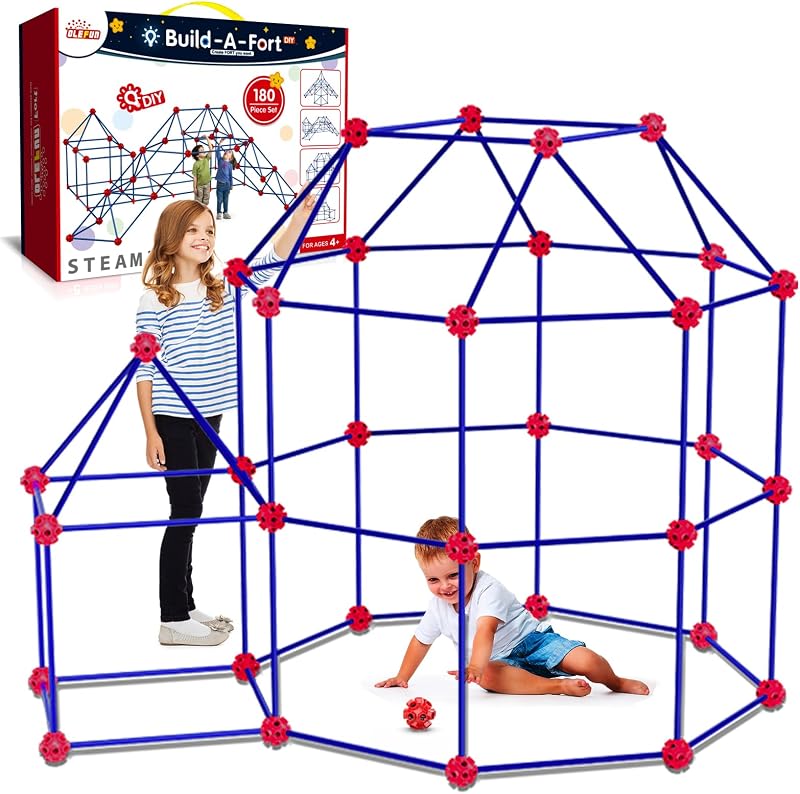
The OleFun 180 Pack Fort Building also offers a 180-piece component pool engineered specifically for children aged 4 through 8, with focused developmental appeal for ages 5 to 8. This kit emphasizes open-ended play tent and tunnel configurations via plastic geometric nodes, serving as a solid alternative for parents prioritizing lightweight plastic components over heavy-duty printed cardboard panels.
Final Verdict
When evaluating whether the make a fort explorer kit specs justify adding it to a playroom, the design succeeds because of how faithfully it translates video game creativity into real-world engineering. The combination of rigid, American-made cardboard panels, high-density foam connectors, and stabilizing gold braces yields genuine walk-in play spaces that outperform blanket-and-chair setups in both stability and aesthetic charm. By turning virtual crafting into hands-on architectural problem solving, it offers an exceptionally healthy, screen-free alternative for gaming enthusiasts.
So, is make a fort explorer kit worth it for your household? If your children love Minecraft, enjoy spatial assembly, and have the indoor floor space to accommodate custom mazes and castles, the kit delivers outstanding entertainment and educational value. Its flat-packing carrying case ensures that cleanup is straightforward, making it a practical, durable investment that can be built, modified, and packed away for countless play sessions.
FAQ
What materials are used to make the Make-A-Fort Minecraft Explorer Kit?
The kit is manufactured in the USA using heavy-duty, reusable corrugated cardboard panels printed with grass and dirt graphics, paired with high-density foam connectors and rigid gold corner braces that secure the panels without adhesives.
Can the Make-A-Fort panels be used outdoors in the yard?
The listing specifies that this is an indoor building kit. Because the panels are constructed from corrugated cardboard, they should not be exposed to outdoor moisture, wet grass, rain, or extreme humidity, which can soften the paper fibers and compromise structural rigidity.
How many pieces are included in a single pack?
A single pack of the Minecraft Explorer Kit includes 124 total items, comprising the building panels, high-density foam connectors, gold braces, an instruction manual, and a dedicated storage carrying case.
What is the recommended age range for this building kit?
The manufacturer recommended age range is 8 to 12 years old. The structural mechanics, panel dimensions, and connector bracing are optimized for the spatial reasoning and fine motor skills of kids within this demographic.
Are tools or glue required to assemble the forts?
No tools, adhesives, or fasteners outside the box are required. The patented design uses custom-slotted high-density foam connectors and gold braces that slip directly onto the panels for quick, tool-free assembly and breakdown.
How these reviews are put together
- 522reviews published
- 2,271products with a buyer rating
- 2,222products with listed features
- 87brands covered
Every number, star and price on this site is read from the Amazon product listing. We do not run lab tests of our own, so scores here are out of 10, based on listed specifications and buyer feedback, not a verdict from a test bench. Prices change without notice; check the listing before buying.


