Starlink Mini Roam Kit Review: Performance for Remote Gaming and Streaming
The Starlink Mini enters the mobile satellite connectivity landscape as a compact, fourth-generation solution engineered specifically for high-mobility users who refuse to disconnect while off the beaten path. Built around an ultra-slim phased array panel, this complete terminal package addresses the primary pain points of legacy mobile satellite terminals: bulky hardware, complicated exterior brackets, and…
10 min read
As Amazon Associates, we earn from qualifying purchases. This means we may receive a small commission at no extra cost to you if you click through and make a purchase.
The Starlink Mini enters the mobile satellite connectivity landscape as a compact, fourth-generation solution engineered specifically for high-mobility users who refuse to disconnect while off the beaten path. Built around an ultra-slim phased array panel, this complete terminal package addresses the primary pain points of legacy mobile satellite terminals: bulky hardware, complicated exterior brackets, and massive power envelopes. For gamers, streamers, and remote workers heading beyond the perimeter of terrestrial cellular towers, the Starlink Mini roam kit delivers a capable, all-in-one terminal that brings low-Earth orbit broadband performance into a package small enough to stow in a standard backpack.
This hardware suits overlanders, van lifers, digital nomads, and remote gamers who require a responsive connection for competitive play and high-definition video streaming without surrendering valuable storage space inside an overland vehicle. Those operating out of an RV with dedicated storage bays or fixed roof racks who do not need backpack-friendly dimensions may find full-size residential hardware more suited to their permanent base camp needs. Furthermore, casual weekend campers who travel strictly within dependable 5G coverage corridors can comfortably look elsewhere, as portable satellite hardware demands clear sightlines to the sky and dedicated off-grid energy planning to realize its full potential.
Download Speeds and Streaming Capabilities
For remote entertainment enthusiasts, raw bandwidth dictates whether an off-grid setup feels like a modern media hub or an exercise in frustration. The Starlink Mini portable Gen4 architecture employs fourth-generation satellite communication technology designed to deliver enhanced download and upload throughput compared to earlier portable hardware tiers. Because the system interfaces directly with low-Earth orbit constellations, Starlink Mini download speeds provide sufficient overhead to handle demanding 4K video streams, large digital game patches, and multi-device content consumption simultaneously. While traditional satellite setups struggle with high-bitrate video feeds due to bandwidth throttling and satellite contention, the v4 antenna engineering inside this compact array optimizes signal capture to maintain sustained throughput.
Streaming high-definition video files while working or camping in isolated regions requires steady throughput rather than intermittent burst speeds. The Starlink Mini streaming performance handles high-bitrate media playback without the aggressive buffering loops common to cellular dead zones. Creators who capture footage on compact field cameras like the insta360 luna ultra light can push high-resolution media to cloud repositories or broadcast live streams from remote destinations, supported by the hardware’s enhanced upload capability. The 32-channel system architecture manages simultaneous data streams efficiently, keeping background cloud syncs from stalling an active video broadcast.
Although the product listing highlights enhanced upload and download throughput driven by its fourth-generation hardware, actual operational speeds will inherently fluctuate depending on satellite constellation density, atmospheric conditions, and physical obstacles. A completely unobstructed sky view remains critical for sustaining peak data rates. Users should anticipate that heavy tree cover or steep canyon walls will degrade transfer rates regardless of antenna engineering. Under open skies, however, the Gen4 phased array maintains the signal integrity required for multi-screen entertainment and data-intensive workflows.
Latency Stability and Remote Gaming Experience
Latency represents the defining barrier between playable remote connectivity and unplayable lag spikes. Traditional geostationary satellite internet routes signals through satellites stationed over 22,000 miles above Earth, producing inherent round-trip latencies of 600 milliseconds or higher. In contrast, Starlink Mini latency benefits from low-Earth orbit positioning at roughly 350 miles altitude, cutting physical transit distances dramatically. When paired with the 32-channel signal processing integrated into the Gen4 dish, this architecture keeps ping times low enough to make modern online multiplayer gaming practical in locations that lack cellular service entirely.
Evaluating the Starlink Mini for gaming reveals impressive competency in cooperative games, real-time strategy titles, and popular battle royales where consistent ping matters more than theoretical peak download speed. While hardcore competitive esports athletes accustomed to sub-10ms fiber lines may notice minor micro-variations during satellite handoffs, the baseline stability of the v4 antenna array handles lobby matchmaking, voice communication, and server packet exchanges smoothly. Voice chat applications remain intelligible without clipping, and server disconnects remain rare provided the terminal maintains an unobstructed sightline to passing orbital paths.
Jitter management on the Starlink Mini relies heavily on local wireless distribution and system impedance, with the hardware rated at 14 ohm impedance and a maximum wireless range of 350 feet. Gamers setting up portable rigs at a campsite or inside an overland build will appreciate that the built-in mesh networking capabilities allow seamless positioning of personal devices away from the antenna’s exterior mounting point. To minimize packet loss and maintain stable frame times during competitive sessions, positioning the terminal on its included adjustable stand to avoid local interference guarantees that hardware processing focuses strictly on active satellite tracking.
Portability, Hardware Dimensions, and RV Setup
Physical footprint is where the Starlink Mini makes its strongest case to travelers. Measuring exactly 19 inches long, 12 inches wide, and an ultra-slim 1.5 inches deep, the terminal abandons the awkward bulk and protruding masts of older satellite hardware. The sleek, minimalist white chassis packs completely flat, allowing it to slide effortlessly into backpack gear sleeves, overland drawer systems, or small camper van cabinets. For solo travelers and minimalists who find standard satellite dishes cumbersome, these physical dimensions transform satellite connectivity from a logistical chore into an everyday carry item.
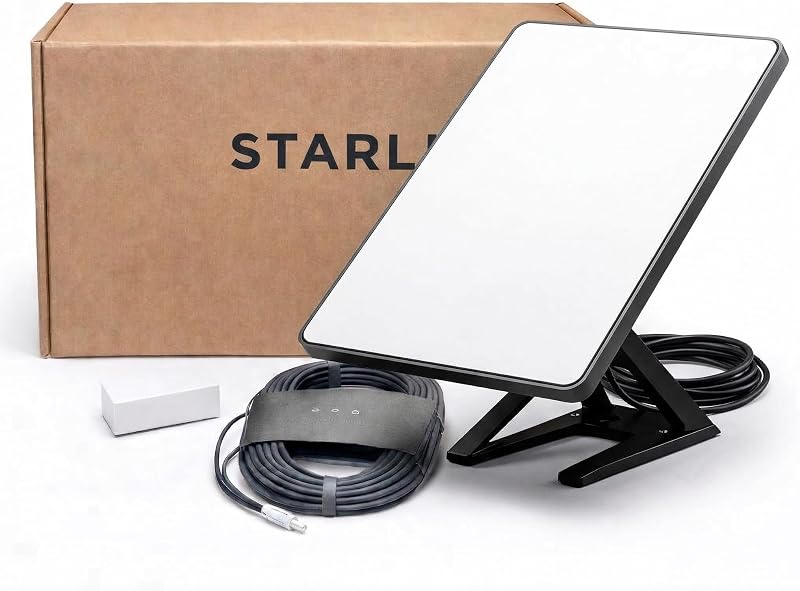
Executing a Starlink Mini RV setup is remarkably simple thanks to the complete hardware package included in the box. The kit ships with the primary antenna panel, an adjustable stand for surface placement, mounting hardware for vehicle or pole installations, and dedicated connection cables. RV owners can choose between temporary deployment on a picnic table using the adjustable stand or securing the panel to ladder mounts and roof rack assemblies using the mounting hardware. The slim 1.5-inch profile presents minimal aerodynamic drag when configured in mobile scenarios, eliminating the need to tear down elaborate mast systems every time the vehicle changes campsites.
Beyond vehicle integration, the system’s travel-focused engineering encourages active use in off-grid creative setups. Whether documenting an overland route or unwinding at camp with artistic projects like the camara instax evo, having high-speed data readily available changes how remote adventurers document and share their experiences. Because the entire assembly arrives as a 1-count complete system requiring minimal manual alignment, non-technical users can achieve active satellite lock within minutes of unpacking the hardware.
Coverage, Mesh Capabilities, and Weather Resilience
Local wireless distribution matters just as much as satellite downlink performance when managing multiple connected devices in camp. The Starlink Mini features a maximum wireless range of 350 feet, casting a wide connectivity bubble around an RV, trailer, or campsite. The integrated mesh networking capabilities allow the system to pair with compatible networking nodes to blanket complex layouts without creating dead zones. This capability ensures that users relaxing inside an insulated camper van retain the same reliable link as those operating laptops or mobile gaming consoles outside by the campfire.
Environmental durability is a mandatory requirement for any exterior mobile terminal. The listing details confirm that the Starlink Mini incorporates advanced Gen4 hardware improvements designed to ensure dependable performance in diverse weather conditions. From desert dust to driving rain and freezing temperatures, the sealed flat-panel construction resists moisture ingress and environmental wear. The internal components operate reliably through changing ambient temperatures, while the flat orientation sheds light debris and wind loads more effectively than curved parabolic dishes.
When bad weather rolls into camp, downtime is often spent streaming movies or relaxing indoors with leisure activities such as assembling a polaroid camera lego set. The Gen4 terminal’s weather resilience ensures that high-definition streaming queues and cloud services remain active during rain events that would typically disrupt weaker mobile hot spots. The durable white casing resists UV degradation from direct solar exposure, maintaining structural integrity across extended seasonal road trips.
Starlink Mini Pros and Cons
Pros
- Ultra-slim 1.5-inch flat panel design
- Fourth-generation satellite hardware enhancements
- Generous 350-foot maximum wireless range
- Integrated mesh networking compatibility
- Complete kit with adjustable stand and cables
- Engineered for diverse weather resilience
Cons
- Listed under generic brand classification
- Limited to 32 channel architecture
- Single warranty description term listed
Who Should Buy the Starlink Mini
Buy It If
- You need an ultra-compact, 1.5-inch thin satellite terminal that packs flat inside an everyday backpack or overland drawer.
- You play online games, stream 4K video, or run remote business meetings from off-grid campsites and dispersed public lands.
- You manage an RV or camper van setup where quick deployment via an included adjustable stand saves valuable setup time.
- You require a broad local wireless footprint up to 350 feet with integrated mesh networking support for multiple camp devices.
Skip It If
- You have dependable access to terrestrial gigabit fiber or fixed home cable internet at your permanent residence.
- You camp exclusively beneath dense, mature forest canopies where obtaining a clear, unobstructed sky view is impossible.
- You require commercial-grade multi-hundred-user satellite infrastructure rather than a compact single-terminal mobile kit.
Starlink Mini Alternatives Worth a Look
While the Starlink Mini excels in ultra-portable and mobile overland scenarios, alternative satellite systems cater to different physical mounting requirements, wireless standards, and deployment plans.
SpaceX Starlink Gen 3 Standard

The SpaceX Starlink Gen 3 Standard kit features a high-speed, low-latency Wi-Fi 6 router designed for residential installations and standard RV use. Buyers who prioritize Wi-Fi 6 wireless routing inside a fixed home or a larger fifth-wheel trailer—and who do not require the compact 1.5-inch backpack profile of the Mini—should consider the Gen 3 Standard for broad residential coverage.
Portable Satellite Internet Mini Kit
The Portable Satellite Internet Mini Kit offers a phased array antenna with integrated Wi-Fi engineered specifically for roam travel, camping, and off-grid remote areas. Travelers seeking a self-contained roam system designed around off-grid vehicle living will find this unit a direct alternative tailored to rugged outdoor travel.
Not Official Starlink Standard Kit

The Not Official Starlink Standard Kit bundles an AX tri-band Wi-Fi system and Gen 3 router for self-install setups with global satellite coverage. Users seeking an AX tri-band Wi-Fi routing architecture for high-density local wireless environments who are comfortable purchasing a third-party bundled kit without warranty coverage should evaluate this configuration.
Final Verdict
When evaluating whether the Starlink Mini is worth it, the answer depends entirely on how much value you place on mobility and form factor. As a mobile satellite solution, the terminal solves the physical bulk limitations that previously made satellite gear an unappealing option for minimalists, motorcyclists, and small camper conversions. With its sleek 19 by 12 by 1.5-inch white chassis, bundled adjustable stand, mounting hardware, and integrated mesh networking, the Starlink Mini portable Gen4 package establishes a new benchmark for go-anywhere broadband accessibility.
For gamers and entertainment streamers, the combination of low-Earth orbit latency stability and 32-channel Gen4 download performance translates into a genuinely functional off-grid entertainment setup. While you must remain conscious of sky clearance to avoid line-of-sight dropouts, the system provides unmatched freedom to play, stream, and collaborate from virtually anywhere. If your lifestyle demands reliable, high-speed connectivity tucked into a remarkably portable footprint, the Starlink Mini delivers the performance and versatility necessary to keep you connected off the grid.
FAQ
What components come inside the Starlink Mini package?
The complete system package includes the primary Gen4 white antenna panel, an adjustable mounting stand for optimal positioning, dedicated mounting hardware for semi-permanent installation, and the required connection cables to link the terminal.
Can you play online multiplayer games on the Starlink Mini?
Yes. Because the system utilizes low-Earth orbit satellite infrastructure rather than geostationary satellites, ping times remain stable enough for multiplayer gaming, co-op sessions, and real-time voice communication under unobstructed sky conditions.
What is the maximum wireless range of the Starlink Mini?
The hardware is rated for a maximum wireless coverage range of up to 350 feet, allowing flexible placement around your campsite, vehicle, or remote workstation.
Does the Starlink Mini support mesh networking?
Yes. The listing confirms that the Starlink Mini features mesh networking capabilities, allowing it to integrate with compatible mesh nodes to provide uniform wireless coverage throughout your vehicle or shelter.
How does the Starlink Mini handle diverse weather conditions?
The hardware features fourth-generation design improvements built to maintain reliable signal reception and mechanical durability across diverse weather environments, including wind, rain, and fluctuating temperatures.
What are the exact physical dimensions of the antenna?
According to the product specifications, the Starlink Mini measures 19 inches in length, 12 inches in width, and 1.5 inches in height, giving it a flat, space-efficient form factor.
How these reviews are put together
- 556reviews published
- 2,271products with a buyer rating
- 2,222products with listed features
- 87brands covered
Every number, star and price on this site is read from the Amazon product listing. We do not run lab tests of our own, so scores here are out of 10, based on listed specifications and buyer feedback, not a verdict from a test bench. Prices change without notice; check the listing before buying.


