DJI Avata 3 Flight Test: 8K 360 Immersion and Control
The DJI Avata 360 enters the cinematography market as a hybrid CineWhoop built to combine high-velocity acrobatic flight with immersive panoramic capture. Equipped with 1-inch-equivalent imaging sensors, robust O4+ transmission, and an intuitive single-handed controller, this aircraft bridges the divide between directional FPV lines and unlimited virtual framing. In this comprehensive DJI Avata 3 review,…
9 min read
As Amazon Associates, we earn from qualifying purchases. This means we may receive a small commission at no extra cost to you if you click through and make a purchase.
The DJI Avata 360 enters the cinematography market as a hybrid CineWhoop built to combine high-velocity acrobatic flight with immersive panoramic capture. Equipped with 1-inch-equivalent imaging sensors, robust O4+ transmission, and an intuitive single-handed controller, this aircraft bridges the divide between directional FPV lines and unlimited virtual framing. In this comprehensive DJI Avata 3 review, our analysis confirms an agile, highly capable imaging platform that turns aggressive flight paths into polished cinematic footage right out of the box.
This complete bundle suits aerial cinematographers, extreme sports documentarians, and FPV enthusiasts who demand total creative reframing freedom during post-production without sacrificing flight stability. The included DJI Avata 360 Motion combo provides the reassurance of integrated prop guards and multi-directional spatial awareness, allowing pilots to navigate tight indoor venues and open outdoor spaces with equal confidence. However, casual hobbyists searching for a sub-249g drone to bypass registration or budget toy flyers will find its advanced capabilities and physical mass unnecessary for casual park hops.
Imaging Capabilities and Dual-Mode Recording
The core innovation of this aircraft centers on its optical system. Outfitted with dual 1-inch-equivalent sensors, the drone records panoramic footage at an impressive 8K resolution at 60 frames per second with High Dynamic Range processing. In aerial videography, sensor surface area directly governs how clean shadow details remain when shooting high-contrast daylight scenes. The DJI Avata 3 8K video pipeline delivers remarkable dynamic range, retaining granular textural details in foliage, building facades, and sky gradients without blowing out highlights or crushing dark undertones.
Beyond pure spherical capture, the platform introduces flexible dual modes that allow pilots to adapt their workflow immediately. Operators can transition seamlessly between 360-degree panoramic capture and a dedicated Single Lens mode that shoots traditional wide-angle footage at 4K at 60 frames per second. This versatility transforms the aircraft into a complete production tool. When flying single-lens mode, you capture classic Avata-style high-speed CineWhoop perspectives; switching to 360 mode opens up infinite camera rotation and tilt angles that physical gimbals cannot replicate in real-time.
Infinite rotation capabilities grant complete creative freedom during the editing stage. Because the aircraft captures an unbroken spherical perspective in a single take, editors can track moving subjects, execute inverted horizon rolls, or simulate impossible dolly zooms in post-production without re-flying the route. This reframing power significantly reduces flight risks on complex dynamic shoots, ensuring you never miss a split-second action shot because the camera was angled slightly off-target.
Flight Dynamics and RC Motion Control
Piloting responsiveness represents half of the CineWhoop equation, and the DJI Avata 3 flight performance stands out through its balance of stability and nimble handling. Weighing in at 455 grams, the craft carries substantial aerodynamic authority, resisting atmospheric turbulence while retaining the aggressive acceleration necessary to punch through tight canopy gaps and urban corridors. The enclosed frame keeps center-of-mass concentrated near the propulsion axis, producing razor-sharp yaw changes and smooth tracking through banking turns.
Maneuvering is orchestrated effortlessly through the DJI RC Motion 3 controller, which translates subtle wrist gestures into precise flight vectors. This handheld interface democratizes advanced aerobatics through Easy ACRO routines, enabling operators to execute inverted barrel rolls, sharp 180-degree drift flips, and vertical dives without the steep learning curve traditionally associated with manual stick transmitters. The listing confirms a silicone protective cover and lanyard are bundled directly in the box, safeguarding the motion wand during active field expeditions.
Visual feedback is channeled directly to the included DJI Goggles N3, creating an exceptionally low-latency cockpit view that matches natural head orientation. For pilots considering ecosystem upgrades or comparing field gear like the DJI Google 3 headset, the N3 delivers crisp high-frame-rate feedback that keeps you fully in tune with terrain proximity. Deploying the DJI Avata 3 for FPV missions bridges the divide between accessibility and acrobatic precision, making high-speed proximity flying feel natural from your very first battery pack.
Transmission Range and Signal Reliability
Reliable communication between pilot and aircraft is critical during high-speed low-altitude runs, where physical obstructions pose constant threats. The Avata 360 integrates DJI’s advanced O4+ FHD transmission system, pushing a high-definition 1080p live feed at a steady 60 frames per second straight into your goggles. This high refresh rate prevents motion blur in your visual feed, allowing you to gauge branch thicknesses, doorway clearances, and wire hazards with total confidence.
Under open environmental conditions, the O4+ protocol supports an operational distance reaching up to 20 kilometers, backed by robust anti-interference frequency management. While regulatory guidelines in most jurisdictions mandate maintaining visual observer line of sight, this massive theoretical range ceiling translates directly into exceptional penetration power at close and mid-range distances. Flying behind concrete pillars, through forested trails, or around architectural features results in minimal digital breakup, maintaining a rock-solid link when you need it most.
Power management across extended filming days is handled via the included multi-battery charging hub and three intelligent lithium-ion flight packs. Although the listing does not specify the exact flight time per individual battery pack, having a three-battery rotation paired with a high-efficiency hub ensures continuous flight readiness on remote productions. The bundle also provides a foldable landing pad, a 128GB high-speed micro SD card, and an SD reader, eliminating the need to source auxiliary storage or take-off accessories separately.
Structural Durability and Omnidirectional Sensing
Operating near obstacles requires an airframe engineered to survive physical contact, and the integrated propeller guard provides essential perimeter protection. Unlike standard open-propeller drones that tumble from the sky after clipping a leaf or wall edge, the rigid duct architecture deflects minor impacts, allowing the flight controller to self-correct and maintain lift. This feature proves indispensable for indoor commercial tours, warehouse inspections, and close-proximity sports tracking where margins of error are measured in inches.
Adding an active layer of situational awareness, the DJI Avata 3 obstacle sensing suite incorporates nightscape omnidirectional vision sensors. Traditional optical obstacle avoidance systems typically falter in low-light conditions, but this upgraded nightscape architecture calculates proximity across multi-directional visual planes even as ambient lighting fades. This capability provides pilots navigating twilight environments or dimly lit indoor venues with real-time positional buffers that prevent catastrophic collisions.
When comparing safety benchmarks against earlier CineWhoops like the drone DJI Avatar 2, the inclusion of comprehensive sensing hardware marks a notable evolution for enthusiast pilots. Pilots should note one operational detail highlighted in the listing specifications: due to platform compatibility issues, the companion DJI Fly application is no longer distributed through the Google Play Store. Android device owners must download the official installation file directly from DJI’s website to activate their hardware, calibrate sensors, and apply system firmware updates.
DJI Avata 360 Pros and Cons
Pros
- Dual 1-inch-equivalent sensors with 8K 360 recording
- Flexible dual modes for 360 and 4K filming
- Stable O4+ transmission reaching up to 20 kilometers
- Nightscape omnidirectional obstacle sensing system
- Integrated propeller guard for physical perimeter protection
- Complete Fly More package with three intelligent batteries
Cons
- Heavier 455-gram airframe requiring civil aviation registration
- DJI Fly Android application requires manual website installation
- Single-lens recording mode capped at 4K resolution
Who Should Buy the DJI Avata 360
Determining whether this CineWhoop belongs in your gear collection depends primarily on your creative goals, comfort with post-production workflows, and flight environment requirements.
Buy It If
- You want full 360-degree reframing flexibility in 8K resolution alongside traditional 4K CineWhoop flight paths.
- You value intuitive single-handed wrist flight controls with the bundled RC Motion 3 and Goggles N3 combo.
- You need an impact-resistant airframe with integrated propeller guards and nightscape omnidirectional obstacle detection for close-proximity filming.
- You prefer an all-inclusive package containing three flight batteries, charging hub, storage card, and transport bag out of the box.
Skip It If
- You exclusively require an ultralight drone weighing under 249 grams to bypass civil aviation registration guidelines.
- You only produce standard forward-facing landscape video and have no use for 360-degree reframing workflows in post-production.
- You prefer conventional twin-stick manual radio controllers and dislike single-handed motion-based piloting interfaces.
DJI Avata 360 Alternatives Worth a Look
If the specialized panoramic dual-lens architecture of the Avata 360 does not align with your specific piloting preferences or aerial filming needs, several alternative aircraft offer distinct advantages.
2K HD FPV Drone

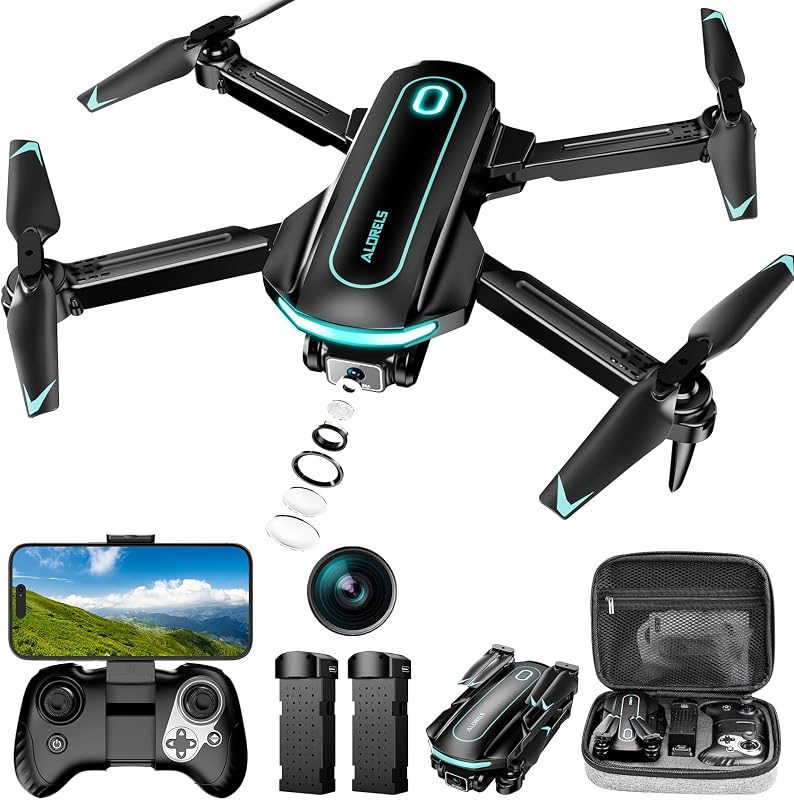
The 2K HD FPV Drone represents an entry-level starter option tailored specifically for beginners, teens, and casual flyers. Equipped with altitude hold, one-key takeoff and landing, three selectable speed modes, headless orientation mode, and two included flight batteries, this foldable aircraft prioritizes low-stakes learning over broadcast imaging. It serves as a suitable training craft for operators who want basic FPV familiarity before investing in high-tier cinematic platforms.
DJI Mini 4K
For aerial photographers who prioritize traditional stabilized landscape capture and ultralight portability, the 3-Axis Gimbal DJI Mini 4K drone presents an attractive alternative. Weighing under 249 grams to skirt regulatory registration requirements in numerous territories, this platform features a mechanical 3-axis stabilized 4K UHD camera, up to 31 minutes of flight endurance per battery, wind resistance, auto-return functionality, and a 10 km transmission range. It is ideal for creators who require steady scenic establishing shots rather than fast acrobatic CineWhoop immersion.

Mini Drone with 2 Batteries
The Mini Drone with 2 Batteries is designed primarily for kids and casual hobbyists seeking fun indoor flying features. This compact foldable model includes a dedicated carrying case, trajectory flight planning, gravity sensor control, 360-degree stunt flips, and a 1080P HD FPV camera. Hobbyists searching for a simple, accessible recreation drone without complex post-processing demands will appreciate its straightforward flight mechanics.
Final Verdict
The DJI Avata 360 sets a compelling benchmark in aerial videography by successfully synthesizing high-speed CineWhoop acrobatics with the boundless framing possibilities of 8K panoramic recording. The combination of dual 1-inch-equivalent sensors, responsive O4+ digital video transmission, and robust nightscape omnidirectional obstacle sensing delivers impressive confidence when navigating complex environments. With intuitive motion steering that lowers the barrier to performing complex aerial maneuvers, the system bridges the technical divide between novice pilots and veteran content creators.
When assessing whether the DJI Avata 3 is worth it, the complete Fly More bundle proves its value through sheer versatility and comprehensive out-of-the-box hardware inclusion. Having three intelligent flight batteries, a high-capacity charging hub, Goggles N3, and the RC Motion 3 bundled together eliminates the need for costly immediate accessories. For cinematographers, content creators, and action sports enthusiasts seeking to capture impossible angles with minimal setup friction, this aircraft represents an unmatched creative tool for modern aerial storytelling.
FAQ
What video resolution does the DJI Avata 360 shoot?
The aircraft captures 360-degree panoramic video at up to 8K resolution at 60 frames per second in HDR using its dual 1-inch-equivalent sensors. When switched to Single Lens mode for traditional forward-facing CineWhoop capture, it records wide-angle footage at 4K resolution at 60 frames per second.
What is included in the DJI Avata 360 Motion Fly More Combo?
The package includes the DJI Avata 360 drone, DJI RC Motion 3 controller with lanyard, DJI Goggles N3, three intelligent flight batteries, charging hub, gimbal protector, two pairs of spare propellers, screwdriver, foldable landing pad, USB-C cable, 128GB micro SD card, SD card reader, cleaning kit, silicone controller cover, and sling bag.
How far can the DJI Avata 360 transmit video?
The drone utilizes DJI O4+ FHD transmission technology, which delivers a low-latency 1080p live feed at 60 frames per second with a maximum operational range of up to 20 kilometers under optimal, interference-free conditions.
How do you install the DJI Fly app on Android devices?
Due to platform compatibility issues, the DJI Fly app is not available on the Google Play Store. Android users must navigate directly to the official DJI website using their mobile browser to download and install the official APK file manually.
Does the DJI Avata 360 feature obstacle detection?
Yes, the drone features integrated nightscape omnidirectional obstacle sensing that provides spatial awareness in daylight and dim lighting conditions, complemented by a rigid built-in propeller guard that protects the blades during physical contact.
How these reviews are put together
- 976reviews published
- 2,271products with a buyer rating
- 2,222products with listed features
- 87brands covered
Every number, star and price on this site is read from the Amazon product listing. We do not run lab tests of our own, so scores here are out of 10, based on listed specifications and buyer feedback, not a verdict from a test bench. Prices change without notice; check the listing before buying.