Nikon D60 Hands-Off Breakdown: Can a Classic DSLR Deliver?
The Nikon D60 represents a notable chapter in consumer camera history, engineered to provide dedicated single-lens reflex control in a lightweight package. Built around a 10.2-megapixel APS-C DX-format sensor and paired with a stabilized zoom lens, this model serves as a straightforward photographic instrument focused purely on traditional still capture. Our verdict is that the…
9 min read
As Amazon Associates, we earn from qualifying purchases. This means we may receive a small commission at no extra cost to you if you click through and make a purchase.
The Nikon D60 represents a notable chapter in consumer camera history, engineered to provide dedicated single-lens reflex control in a lightweight package. Built around a 10.2-megapixel APS-C DX-format sensor and paired with a stabilized zoom lens, this model serves as a straightforward photographic instrument focused purely on traditional still capture. Our verdict is that the Nikon D60 delivers a satisfying, tactile shooting experience for hobbyists who appreciate retro mechanics and classic image rendering, though its vintage specification sheet naturally lacks modern tracking speeds and high-resolution versatility.
This camera package best suits photography students learning exposure fundamentals, retro hardware collectors, and casual visual enthusiasts looking for a dedicated optical finder without modern electronic clutter. It is also an accessible choice for those practicing intentional framing with physical dials. However, commercial creators needing high-megapixel crops, rapid action sports photographers, and mobile content creators who depend on seamless wireless workflows or advanced video tools should look at modern alternatives instead.
Image Sensor and Resolution Performance
At the center of the photographic experience is the 10.2-megapixel APS-C DX-format imaging sensor. By contemporary standards where consumer sensors often exceed 24 megapixels, this resolution may appear modest on paper. In practice, the 10.2-megapixel output provides ample resolution for standard photo prints, web galleries, and everyday visual documentation. The sensor layout generates clean files with an expanded ISO minimum of 100, allowing hobbyists to shoot in bright daylight with minimal baseline grain and dependable tonal fidelity.
Evaluating overall nikon d60 image quality reveals a distinctive character that vintage digital shooters actively seek out. Unlike modern digital sensors that lean heavily on aggressive onboard noise reduction and computational sharpening, this sensor creates natural skin tones and rich color depth when guided by balanced ambient light. Photographers who examine raw image performance will appreciate the inclusion of Nikon’s NEF file format alongside compressed JPEG options. The ability to shoot simultaneous NEF (RAW) plus JPEG lets users inspect quick proofs while preserving uncompressed sensor data for deliberate desktop adjustments.
While newer mirrorless options such as the nikon z 30 emphasize hybrid video features and expansive low-light processing, the sensor architecture here remains firmly dedicated to traditional still photography. Cropping margins are tighter due to the 10.2-megapixel boundary, meaning composition must be calculated deliberately inside the frame rather than heavily altered in post-production. For enthusiasts looking to develop disciplined framing habits, this constraint serves as a practical creative exercise rather than a simple technical limitation.
Optics and Optical Image Stabilization
The camera arrives bundled with the versatile AF-S DX NIKKOR 18-55mm f/3.5-5.6G Vibration Reduction zoom optic. This lens covers wide-angle landscapes at 18mm through classic portrait perspective at 55mm, establishing a versatile everyday range for travel, street scenes, and family gatherings. Featuring a maximum aperture of f/3.5 at the wider focal length, the lens manages moderate depth of field while keeping the overall front element compact and lightweight.
A primary strength of the nikon d60 18-55mm lens package is its integrated Vibration Reduction mechanism. Because the camera body itself does not house in-body sensor stabilization, moving optical stabilization into the lens elements ensures steady framing through the glass. This optical stabilization counters minor hand tremors during slower handheld exposures, expanding practical shooting viability in twilight or dim indoor settings without requiring an immediate switch to a tripod.
The standard Nikon F-mount connection ensures mechanical stability between body and glass. However, shoppers examining the broader ecosystem must pay close attention to lens nomenclature. The camera requires lenses equipped with internal autofocus motors (such as AF-S and AF-I designations) to achieve automatic focusing, as the lightweight body lacks an internal mechanical drive spindle. Exploring vintage primes or manual focus glass remains fully possible, but autofocus functionality remains tied strictly to the design of each attached optic.
Metering System and Shooting Responsiveness
Exposure accuracy is managed through Nikon’s 3D Color Matrix Metering II system, a reliable evaluative tool designed to balance challenging scenes containing intense highlights and deep shadows. The camera evaluates scene brightness, contrast distribution, and color data across the frame to calculate balanced automatic exposures. Supplementing automatic operation are dedicated manual, aperture-priority, and shutter-speed-priority modes, giving photographers full creative control over aperture depth and motion blur across shutter speeds ranging from 30 seconds down to 1 second.
When tracking moving subjects, nikon d60 autofocus performance behaves reliably for static portraits, architecture, and casual street photography. Focusing acquisition is swift when locking onto high-contrast subjects in generous light, though it naturally lacks the multi-point subject recognition and eye-tracking algorithms found in modern bodies. For candid family moments and deliberate artistic compositions, the focusing mechanics provide straightforward, predictable confirmation.
Continuous shooting performance tops out at 3 frames per second, catering to modest burst requirements rather than fast sports sequences. Capturing a running pet or a dynamic walking portrait is manageable when timing bursts carefully. For users accustomed to ultra-fast action cameras or rugged outdoor models like the nikon coolpix aw130, the conservative continuous shooting rate reinforces this model’s role as a deliberate, thoughtful photography platform rather than an action-capture rig.
Body Ergonomics, Optical Viewfinder, and LCD Display
Weighing in at 1.6 pounds, the nikon d60 dslr body strikes an effective balance between sturdy construction and portable handling. The deep right-hand grip provides comfortable support during extended photo walks, allowing fingers to rest naturally near the primary shutter button and control wheel. Physical buttons are clearly separated, giving the user tactile confirmation that reduces reliance on deep digital menu navigation.
A key operational highlight is the nikon d60 optical viewfinder, which routes an authentic, latency-free view of the scene directly through the lens mirror assembly. Unlike electronic displays that suffer from motion lag or washed-out visibility in harsh midday sunlight, an optical viewfinder provides an immediate, natural connection to the subject. Photographers who enjoy the analog feel of traditional single-lens reflex hardware will find this classic viewing mechanism distinctly rewarding.
On the back of the camera sits a 2.5-inch TFT-LCD monitor with 230,000 pixels and onboard brightness adjustment. While compact compared to contemporary high-resolution touchscreens like those found on travel zooms such as the nikon coolpix s9900 digital camera, this screen introduces an intelligent orientation sensor. The monitor automatically detects horizontal and vertical camera positioning, rotating interface graphics and playback views accordingly. Maintenance is further supported by an Active Dust Reduction System with Airflow Control, which works to shake loose loose debris from the optical pathway.
Nikon D60 Pros and Cons
Pros
- Included 18-55mm lens features optical vibration reduction
- Lightweight 1.6-pound body with ergonomic grip
- Active Dust Reduction System with Airflow Control
- Continuous shooting up to 3 fps
- Accurate 3D Color Matrix Metering II
Cons
- Modest 10.2-megapixel photo sensor resolution
- Compact 2.5-inch 230K-pixel fixed rear display
- Memory card not included in box
Who Should Buy the Nikon D60
Buy It If
- You are seeking an authentic platform for nikon d60 for beginner photography practice with physical exposure dials.
- You appreciate the distinctive color science and film-like tonal output of classic 10.2-megapixel APS-C sensors.
- You want a complete starter kit featuring an optically stabilized 18-55mm zoom lens right out of the box.
- You prefer composing shots through a bright, latency-free optical reflex viewfinder instead of an electronic screen.
Skip It If
- You regularly photograph fast-moving sports, wildlife, or dynamic action that demands burst speeds well beyond 3 fps.
- You expect high-resolution articulated touchscreens or automated mobile wireless file transfers.
- You require integrated memory media in the box, as SD and SDHC cards must be acquired separately.
Nikon D60 Alternatives Worth a Look
Shoppers considering a capable starter DSLR or creative photographic tool will find several alternative options on the market, ranging from modernized entry-level DSLRs to high-resolution digital cameras.
24.1 Megapixel CMOS

The 24.1 Megapixel CMOS kit provides an entry-level platform built around a substantially higher-resolution APS-C sensor alongside Full HD video recording and built-in Wi-Fi. It includes an EF-S 18-55mm f/3.5-5.6 IS II stabilized zoom lens designed for beginner photographers. This option makes more sense for buyers who require modern wireless connectivity for direct smartphone transfers and significantly larger image files for aggressive digital cropping.
Canon EOS Rebel T7 DSLR

Supplied as an expanded starter package, the Canon EOS Rebel T7 DSLR bundle pairs a 24.1-megapixel APS-C CMOS sensor with two separate lenses: an EF-S 18-55mm standard zoom and an EF 75-300mm telephoto optic. It also includes Full HD video recording and Wi-Fi features in a black finish. Photographers looking for extended telephoto reach immediately out of the box will appreciate the broader focal range provided by this double-zoom configuration.
8K Digital Cameras for Photography
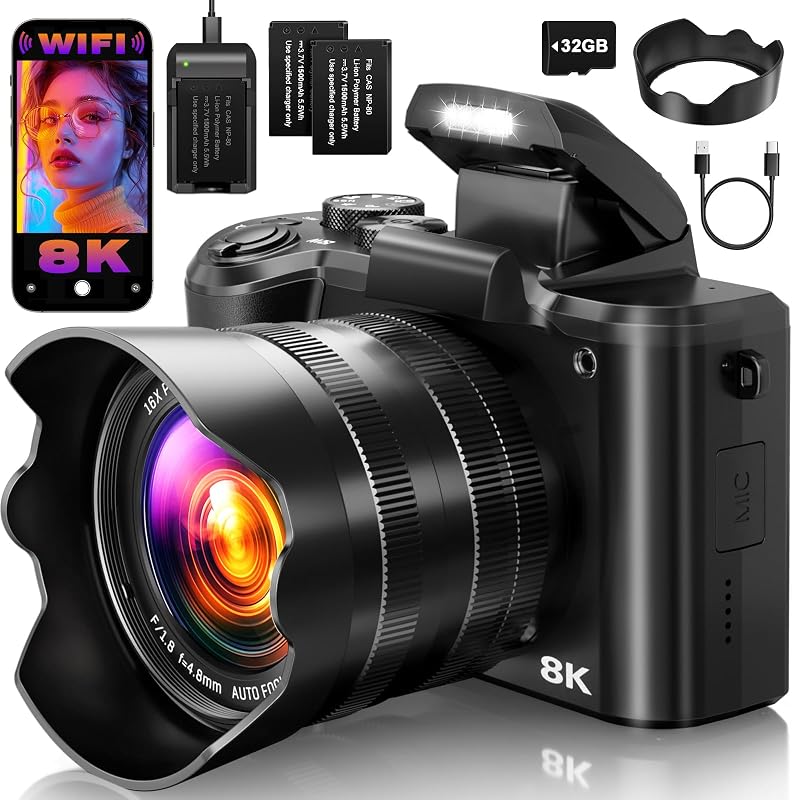
The 8K Digital Cameras for Photography system represents a completely different approach, sporting an 88MP resolution claim, 8K video capture, a dual-lens layout, 16X digital zoom, and built-in Wi-Fi. Packaged with a touchscreen, lens hood, TF card support, and two batteries with a dedicated charging stand, this unit caters primarily to content creators and vloggers who prioritize ultra-high video resolution specifications and bundled accessories over traditional mechanical DSLR optics.
Final Verdict
When addressing whether the question is nikon d60 worth it today, the answer hinges on realistic expectations. As a pure photographic device, the camera remains a capable, well-built instrument for exploring the fundamentals of exposure, aperture control, and focal framing. Its pairing of an ergonomic 1.6-pound body with an optically stabilized 18-55mm zoom lens provides immediate utility for hobbyists who enjoy the process of deliberate composition through an optical glass pathway.
At the same time, users must recognize the operational realities defined by its era. Modest 10.2-megapixel file sizes, a 3 fps continuous shooting cap, and a compact 2.5-inch fixed rear display place it firmly in the classic category. If your photographic ambitions emphasize mechanical charm, vintage digital color aesthetics, and manual learning, this classic package remains a deeply enjoyable photographic companion.
FAQ
Does the Nikon D60 include a memory card in the package?
No, the listing specifies that SD and SDHC memory cards are not included and must be purchased separately to capture and store images.
What file formats does this camera record?
The camera supports uncompressed NEF (RAW) image files, standard JPEG (Exif 2.21) files, and a simultaneous NEF (RAW) plus JPEG recording mode for maximum editing flexibility.
How does the camera prevent dust buildup on the internal sensor?
The body incorporates an Active Dust Reduction System paired with Airflow Control, which works mechanically to channel airflow and dislodge loose dust particles away from the sensor surface.
Can the rear LCD screen adjust its display when shooting vertically?
Yes, the 2.5-inch TFT-LCD monitor features automatic orientation detection, which shifts graphic readouts and preview displays between horizontal and vertical layouts automatically.
What is the maximum continuous shooting speed available?
The camera captures continuous burst sequences at a rate of up to 3 frames per second, making it suitable for capturing paced action and sequential portraits.
How these reviews are put together
- 540reviews published
- 2,271products with a buyer rating
- 2,222products with listed features
- 87brands covered
Every number, star and price on this site is read from the Amazon product listing. We do not run lab tests of our own, so scores here are out of 10, based on listed specifications and buyer feedback, not a verdict from a test bench. Prices change without notice; check the listing before buying.


