Raspberry Pi 4 Model B 8GB: Performance Breakdown for Gamers
The Raspberry Pi 4 8GB stands as the highest-memory configuration of the fourth-generation single-board computer from Raspberry Pi, combining a 64-bit quad-core processor with substantial memory capacity for hobbyists and power users alike. In this Raspberry Pi 4 Model B 8GB review, the board demonstrates strong multi-tasking and background service reliability, offering a massive pool…
By Mark Archer
9 min read
As Amazon Associates, we earn from qualifying purchases. This means we may receive a small commission at no extra cost to you if you click through and make a purchase.
The Raspberry Pi 4 8GB stands as the highest-memory configuration of the fourth-generation single-board computer from Raspberry Pi, combining a 64-bit quad-core processor with substantial memory capacity for hobbyists and power users alike. In this Raspberry Pi 4 Model B 8GB review, the board demonstrates strong multi-tasking and background service reliability, offering a massive pool of system memory for complex operating environments, though gaming performance remains anchored by its core compute silicon.
This board suits entertainment enthusiasts who want an all-in-one platform capable of hosting home theater services, managing continuous network downloads, and handling legacy console emulation without exhausting physical RAM. Gamers focused strictly on standalone retro emulation from 8-bit to 32-bit generations may find similar in-game frame rates on lower-memory editions of the baseline raspberry pi 4, while power users seeking high-end 3D graphics rendering will ultimately need more advanced graphics silicon.
Processing Power and Emulation Performance
At the center of the hardware architecture sits the Raspberry Pi 4 BCM2711 Cortex-A72 quad-core processor running at 1.5GHz. While some spec sheets mention a 5 GHz figure due to listing entry errors, the board operates on the 1.5GHz Broadcom BCM2711 silicon. This represents an architecture upgrade over older microarchitectures, providing the out-of-order execution pipelines necessary to tackle a wide variety of retro console platforms. Operating systems such as Raspberry Pi OS take direct advantage of these 64-bit CPU cores to decode instructions with noticeably lower latency than prior generations.
When assessing Raspberry Pi 4 8GB retro gaming, user experience depends heavily on the targeted console generation. Classic 8-bit and 16-bit consoles run with full frame stability, zero stutter, and ample overhead for custom shaders or latency-reduction settings. For fifth-generation and select sixth-generation systems, Raspberry Pi 4 8GB emulation performance delivers solid playability across PlayStation 1 titles and many Nintendo 64 games. However, systems like the Sega Dreamcast or PlayStation Portable push the integrated VideoCore graphics and CPU clock limits, where frame rates can drop in complex 3D scenes regardless of how much unused memory remains available.
The notable advantage of the 8GB memory footprint in emulation setups comes down to system caching and large media frontends. Gamers running heavy graphical user interfaces such as EmulationStation, Pegasus, or custom media-rich RetroPie skins can load extensive video previews, box art scrape databases, and dynamic themes without encountering out-of-memory crashes. Running a lightweight desktop environment or background torrent services alongside your gaming front-end remains entirely viable because the operating system never has to purge disk caches to keep games running.
Memory Headroom and Multi-Tasking Capabilities
For users contemplating a Raspberry Pi 4 Model B RAM upgrade from 2GB or 4GB variants, the 8GB capacity introduces substantial architectural flexibility. Operating inside a native 64-bit Linux distribution, the full 8GB DDR4 RAM space is mapped without requiring physical address extension hacks. This enables advanced memory allocations, such as creating dedicated RAM disks for fast temporary scratch space, compiling large source repositories natively without running out of swap space, or keeping dozens of browser tabs open while performing background compute tasks.
Enthusiasts building unified media and entertainment servers gain substantial utility from this memory tier. Rather than dedicating the single-board computer exclusively to one task, the board comfortably hosts container platforms like Docker. A single 8GB unit can simultaneously execute local network ad-blocking, home automation controllers, a database instance, and a media indexer. On lower RAM tiers, these simultaneous tasks trigger intensive disk swap activity on the microSD card, which degrades general system responsiveness and drastically shortens storage lifespan.
While discussions around next-generation boards like the raspberry pi 16gb explore extreme memory capacities for enterprise edge clusters, 8GB represents the peak capacity for the fourth-generation series. This makes it the most capable hardware revision of this layout for memory-dense Linux tasks. It allows users to run desktop-grade productivity suites, web browsers, and media software in parallel without encountering aggressive kernel out-of-memory terminations.
Media Center and Display Capabilities
The board features two micro HDMI outputs, granting full Raspberry Pi 4 8GB dual 4K display functionality. The system silicon supports hardware decoding for modern high-resolution formats, including 4Kp60 playback on compatible operating systems. Running two external monitors simultaneously transforms the compact board into a flexible digital signage player or dual-screen retro battlestation, where one display outputs the game while the second shows walkthroughs, chat applications, or system telemetry.
Deploying this board as a dedicated Raspberry Pi 4 8GB media server highlights the value of its updated input and output pipeline. Unlike older single-board models where USB ports and Ethernet traffic shared a single internal bus, this board features a native Gigabit Ethernet controller and two dedicated USB 3.0 ports. High-bitrate media files stream smoothly across local networks, while attached USB external hard drives transfer data without choking network bandwidth. This makes it an effective personal cloud streaming hub for high-definition video collections.
For home theater setups, the board includes a 3.5 mm audio jack that supports composite video output and analogue audio. Additionally, native audio passing across the micro HDMI ports delivers multi-channel digital audio to modern receivers or television displays. The board handles local media libraries effortlessly, provided users mount proper storage devices via the high-speed USB 3.0 ports rather than relying exclusively on the microSD card for heavy file reads and writes.
Thermal Management and Hardware Connectivity
Thermal management is a crucial consideration for continuous performance under heavy gaming or transcode loads. The BCM2711 processor generates notable thermal output during sustained 3D emulation or dual-display video decoding. Because the package contains only the bare board, builders must purchase aftermarket cooling components separately. Adding a passive aluminum heatsink case or an active cooling fan is essential to prevent thermal throttling, which dynamically reduces CPU clock frequencies when temperatures exceed safe operating parameters.
Connectivity options cover a broad hardware spectrum, featuring the standard 40-pin GPIO header used across the Raspberry Pi hardware ecosystem. This header enables connection to custom arcade buttons, sensor modules, and secondary expansion boards like Power over Ethernet (PoE) add-ons via the integrated PoE pins. Built-in dual-band 802.11ac wireless and Bluetooth 5.0 BLE streamline wireless gamepad pairing, allowing multiple wireless controllers to link simultaneously without requiring external USB dongles.
Physical power delivery relies on a dedicated USB Type-C port requiring a clean 5V/3A power input. Using an insufficient power supply will trigger low-voltage warnings, which can disrupt attached USB storage and cause instability during peak processor loads. The compact dimensions of 3.74 by 2.76 by 0.98 inches ensure the board fits into standard DIY console enclosures, provided adequate ventilation channels are present.
Raspberry Pi 4 8GB Pros and Cons
Pros
- Generous 8GB DDR4 RAM for heavy multi-tasking
- Dual micro HDMI ports supporting 4Kp60 displays
- Independent Gigabit Ethernet and USB 3.0 channels
- Onboard dual-band 802.11ac wireless and Bluetooth 5.0
- Broad hardware compatibility with standard 40-pin GPIO
Cons
- Bare board package excludes power adapter and cooling
- Cortex-A72 CPU limits higher-end 3D console emulation
- Requires aftermarket heatsink to avoid thermal throttling
Check Raspberry Pi 4 8GB on Amazon
Who Should Buy the Raspberry Pi 4 8GB
Buy It If
- You run multiple containerized network services, home automation setups, and media indexing alongside gaming frontends.
- You need the full 8GB memory footprint for 64-bit Linux multi-tasking, RAM disks, or local software compilation.
- You intend to output to dual displays while keeping memory-heavy applications open in background workspaces.
- You want a compact, low-noise personal streaming server backed by true Gigabit Ethernet and USB 3.0 speeds.
Skip It If
- Your sole objective is playing classic 8-bit or 16-bit retro games where 2GB or 4GB of memory delivers identical performance.
- You expect out-of-the-box hardware with pre-installed cooling, a power supply, or pre-configured software in the package.
- You require smooth performance in demanding sixth-generation or seventh-generation 3D console emulation, which requires faster CPU silicon.
Raspberry Pi 4 8GB Alternatives Worth a Look
If your entertainment setup or compute demands differ from what the standard 8GB model offers, several alternatives provide distinct hardware balances across different processor classes and bundle options.
Libre Computer Le Potato Mini

The Libre Computer Le Potato Mini is a compact single-board computer configured with 2GB of memory, an included USB Wi-Fi 4 dongle, and a passive heatsink. This board represents an appealing choice for builders who prioritize a minimal retro gaming footprint or basic entertainment tasks without requiring high RAM capacities or dual 4K video outputs.
Orange Pi 4 Pro 4GB
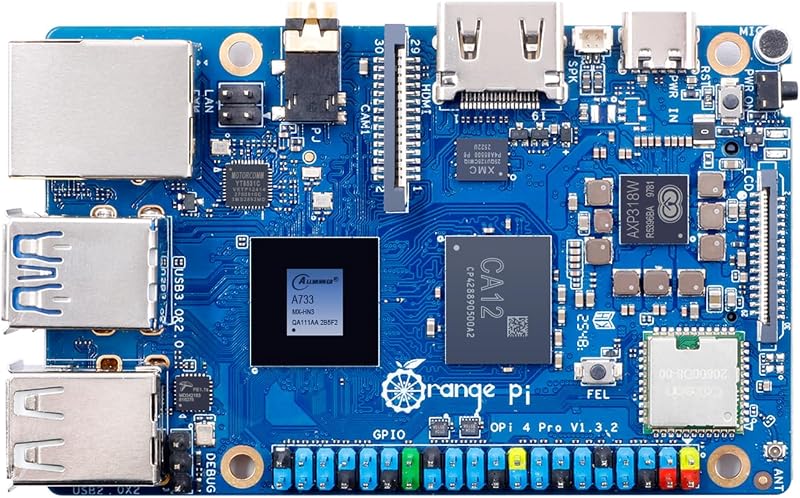
The Orange Pi 4 Pro 4GB features an 8-core 64-bit processor clocked at 2.0GHz, paired with LPDDR5 memory, a 3TOPS AI NPU, Wi-Fi 6, and Bluetooth 5.4. Entertainment enthusiasts seeking a more aggressive processor architecture with onboard AI acceleration and newer wireless standards may prefer this option over the quad-core layout of the fourth-generation Pi.
Raspberry Pi 5 4GB Kit

The Raspberry Pi 5 4GB Kit includes an active cooler and an ABS case, packaging essential accessories right in the box. Shoppers evaluating the generational performance shift in our raspberry pi 5 analysis will find that its higher CPU clock speeds and updated graphics processor deliver substantially better high-end emulation frame rates than the older board, even at a lower memory configuration.
Final Verdict
Evaluating whether the investment is justified hinges entirely on your expected multi-tasking profile. Is Raspberry Pi 4 Model B 8GB worth it? For users setting up dedicated home infrastructure that juggles media playback, background downloading, network services, and a comprehensive gaming frontend, the 8GB DDR4 capacity prevents the operating system from bottlenecking on disk swaps. It is a stable, mature board supported by one of the largest software communities in single-board computing.
However, if your ambition is strictly standalone retro gaming, the extra system memory will largely sit idle during gameplay because emulation frame rates are determined by the 1.5GHz Cortex-A72 cores rather than memory volume. In that scenario, prioritizing a more powerful processor or opting for a lower memory tier will deliver better hardware efficiency. For the multi-purpose enthusiast who wants a reliable mini Linux machine that does everything at once, the 8GB configuration provides the ultimate headroom within the fourth-generation ecosystem.
FAQ
Does the 8GB model improve frame rates in retro games over the 4GB version?
No, the 8GB model uses the identical Broadcom BCM2711 processor clocked at 1.5GHz as the 2GB and 4GB revisions. Frame rates in emulators depend on CPU and GPU processing speed rather than available system memory, meaning games perform identically once the minimum RAM requirement is met.
What operating system is recommended to take advantage of the 8GB RAM?
A 64-bit operating system, such as the 64-bit release of Raspberry Pi OS or 64-bit Ubuntu, is necessary to allow individual processes to address the entire 8GB memory block seamlessly without complex memory paging.
What comes included in the package?
The product package contains only the bare Raspberry Pi 4 Model B 8GB board. Accessories such as a USB-C power supply, microSD card, micro HDMI cables, and cooling solutions must be obtained separately.
Can the board output to two 4K screens at the same time?
Yes, the board features two micro HDMI ports capable of driving dual displays at resolutions up to 4Kp60, provided the operating system and video settings are configured for dual-screen operation.
Does this board require an active cooling fan?
While an active fan is not strictly required for light desktop idling, sustained processor tasks such as compiling software, running 3D emulators, or streaming 4K media generate enough heat to cause thermal throttling without a heatsink or fan.
How these reviews are put together
- 203reviews published
- 2,271products with a buyer rating
- 2,222products with listed features
- 87brands covered
Every number, star and price on this site is read from the Amazon product listing. We do not run lab tests of our own, so a score here is the average rating left by buyers, not a verdict from a test bench. Prices change without notice; check the listing before buying.


