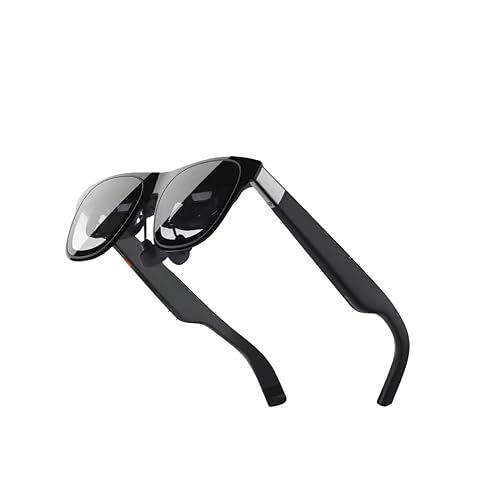
RayNeo Air 4 Pro Review: Giant Screen Immersion for Handheld Gamers
Handheld gamers and entertainment enthusiasts searching for wearable display tech frequently encounter the RayNeo Air 4 Pro, occasionally querying it as the ray nero air 4 pro when tracking down high-refresh eyewear. Designed as a dedicated wearable monitor, this headset projects a massive 201-inch virtual screen directly in front of your eyes using specialized optics…
9 min read
As Amazon Associates, we earn from qualifying purchases. This means we may receive a small commission at no extra cost to you if you click through and make a purchase.
Handheld gamers and entertainment enthusiasts searching for wearable display tech frequently encounter the RayNeo Air 4 Pro, occasionally querying it as the ray nero air 4 pro when tracking down high-refresh eyewear. Designed as a dedicated wearable monitor, this headset projects a massive 201-inch virtual screen directly in front of your eyes using specialized optics and dedicated real-time image processing. Our research indicates that for gamers who want an expansive, cinema-scale view without carrying a bulky desktop monitor or flat panel on the road, it delivers exceptional plug-and-play visual immersion.
This headset is tailored for portable console enthusiasts playing on modern handhelds, frequent flyers who want a private theater in a cramped airline seat, and console players wanting a private display setup. However, shoppers searching for a self-contained virtual reality platform featuring positional head tracking, integrated application stores, or completely wireless operation should look toward traditional standalone headsets instead.
Display Quality and Visual Immersion
When evaluating the RayNeo Air 4 Pro display quality, the standout engineering choice is the inclusion of the Vision 4000 processor. Co-developed with Pixelworks, this chip delivers real-time AI SDR-to-HDR upscaling, edge sharpening, and motion clarity adjustments on the fly. Projecting an expansive 201-inch virtual canvas, the display engine renders over 10 billion colors to deliver rich depth and vibrant tonality. While the technical specifications listed by the manufacturer state a display maximum resolution of 819 x 461, the optical magnification and processing pipeline create a perceived cinema-scale environment that vastly exceeds the physical dimensions of standard handheld panels.
Dynamic range handling is another strong point, as the RayNeo Air 4 Pro HDR10 support elevates high-contrast media far beyond conventional portable LCD monitors. Highlights like streetlights in dark game corridors or sun flares across open-world horizons pop with brightness, while shadow areas retain detail without severe crushing. Gamers coming from earlier display generations, including devices like the ray neo air 3s pro, will appreciate the aggressive contrast processing and calibrated color profiles engineered into the newer Vision 4000 silicon.
Beyond standard 2D viewing, the optics accommodate native 3D movie playback and incorporate an AI depth enhancement algorithm capable of converting conventional 2D video into stereoscopic 3D. This gives movie buffs a private theater environment when streaming films or watching local media files, making long transit sessions feel significantly more engaging.
Gaming Performance and Refresh Rates
Performance remains the central metric for enthusiast gamers, and deploying the RayNeo Air 4 Pro for gaming reveals clear advantages for titles demanding rapid reaction times. Operating at a native display refresh rate of 120Hz, the headset minimizes micro-stutter and frame pacing inconsistencies during high-speed action. Fast camera pans in first-person shooters and rapid drifts in racing simulators stay crisp, avoiding the distracting smearing and ghosting artifacts common on slower 60Hz panels.
Responsiveness in the RayNeo Air 4 Pro 120Hz mode is further bolstered by the hardware pipeline. Because the glasses do not rely on local wireless networks, Bluetooth casting, or software translation layers, input latency remains exceptionally low. Button presses from your controller transfer directly through your host device to the micro-display without perceptible lag, maintaining competitive timing across fast-paced action games.
Thermal stability during extended play sessions also benefits from the physical architecture. By eliminating an internal lithium-ion battery, the chassis avoids generating internal heat against your forehead or nose bridge. The hardware stays cool even when driven at full 120Hz brightness during multi-hour gaming marathons, preserving comfort and sustained visual fidelity without thermal throttling.
Console and Handheld Compatibility
Hardware versatility is vital for a portable display, and the physical RayNeo Air 4 Pro specs emphasize a clean, universal USB-C physical connection. Operating via DisplayPort Alternate Mode, the headset requires no companion applications, accounts, or driver installations for core video out functionality. Connecting the RayNeo Air 4 Pro Steam Deck setup involves plugging the supplied USB-C cable directly into the console’s top port, immediately mirroring the SteamOS interface or desktop mode to the virtual 201-inch screen.
Living-room and desk gamers can also integrate the RayNeo Air 4 Pro PS5 configuration by leveraging direct USB-C output on supported consoles or appropriate video signal routing. The manufacturer highlights cross-platform support across Android XR, PlayStation VR, SteamVR, PC, and modern mobile phones including the iPhone 15, 16, and 17 series. This broad standard support means you can transition from an evening gaming session into a productive remote workday without swapping specialized accessories.
For mobile workstation tasks, the glasses connect seamlessly to modern laptops like the macbook air m4 13 inch 256gb, giving you an expansive private canvas for video editing, writing, or terminal workflows in crowded coffee shops. Power users driving heavy multi-app pipelines on desktop setups such as the mac studio m4 max 64gb can similarly leverage the glasses as a secondary or dedicated preview monitor that leaves physical desk space completely uncluttered.
Spatial Audio and Acoustic Design
Audio hardware on wearable displays is frequently an afterthought, but RayNeo partnered with Bang & Olufsen to tune a quad-speaker array integrated directly into the temple arms. These four precision micro-speakers produce an immersive 360-degree spatial soundstage that directs directional cues accurately around your ears. In tactical games, acoustic placement of footsteps and environmental cues helps maintain spatial awareness without requiring bulky over-ear headphones.
To address sound leakage in shared spaces, the temple arms incorporate a dedicated Whisper Mode. This acoustic configuration uses phase-canceling sound dispersion to keep dialogue and game effects audible to the wearer while drastically reducing acoustic spill to neighboring passengers on trains or planes. For environments requiring extra acoustic power, the manufacturer notes that an optional Sound Tube accessory is available separately to boost volume levels by up to 15dB.
Ergonomics, Build, and Daily Usability
Carrying a display on your face for hours requires meticulous weight distribution. At just 2.88 ounces, model XRGF39-1 ranks among the lightest personal display systems on the market. Removing the onboard battery not only prevents long-term cell degradation but eliminates significant physical mass, keeping downward pressure off the bridge of your nose during long movie sessions or gaming sessions.
The trade-off of this featherweight design is direct dependency on the connected host device for operating power. When connected to a Steam Deck, Nintendo Switch, or smartphone, the glasses draw power directly through the USB-C link. While this ensures an instant-on experience without needing to recharge the glasses separately, users planning all-day mobile sessions will want to factor their host console’s battery drain into extended travel plans.
RayNeo Air 4 Pro Pros and Cons
Pros
- Fluid 120Hz refresh rate for fast-paced gaming
- Massive 201-inch virtual display experience
- Pixelworks Vision 4000 chip with AI upscaling
- Featherweight 2.88-ounce frame with no internal battery
- Four-speaker spatial audio tuned by Bang & Olufsen
- Driver-free USB-C plug-and-play console connectivity
Cons
- No internal battery requires drawing power from host devices
- Listing notes an unusual display resolution spec of 819 x 461
- Lacks standalone computing without an external source tether
Check RayNeo Air 4 Pro on Amazon
Who Should Buy the RayNeo Air 4 Pro
Buy It If
- You own a Steam Deck, ROG Ally, or compatible smartphone and want a massive 201-inch screen anywhere you travel.
- You prioritize low-latency, fluid motion clarity through a native 120Hz display refresh rate for competitive gaming.
- You want a lightweight, 2.88-ounce wearable monitor that does not create heat or require charging an internal battery.
- You frequently watch movies in transit and value HDR10 dynamic range with calibrated Bang & Olufsen spatial audio.
Skip It If
- You want a fully standalone VR headset featuring six-degrees-of-freedom positional tracking and an onboard operating system.
- Your primary playback devices lack a DisplayPort-compatible USB-C port or appropriate display adapter hardware.
- You require a completely wireless screen connection without any physical cable running to your device.
RayNeo Air 4 Pro Alternatives Worth a Look
Shoppers browsing wearable smart eyewear will encounter several alternative models tailored for capture, artificial intelligence, and everyday wireless tasks rather than dedicated console video output.
Photo Capture,Real-Time Translation,Object Recognition,Open-Ear Music

The Photo Capture,Real-Time Translation,Object Recognition,Open-Ear Music glasses are designed around daily utility, featuring an integrated camera capable of 4K HD video recording, hands-free Bluetooth calling, and live translation tools. Unlike the RayNeo display glasses, this model focuses on POV content capture and audio assistance rather than projecting an expansive 201-inch external virtual gaming screen.
AI Assistant

For shoppers seeking an intelligent audio-visual daily accessory, the AI Assistant smart glasses feature photochromic lenses, blue light protection, open-ear audio, and built-in ChatGPT access for hands-free queries. Readers who need intelligent voice tools and eye protection instead of a high-refresh console gaming monitor will find this model better suited to casual daily routines.
Object Recognition

The Object Recognition eyewear integrates open-ear speakers, transparent lenses, an AI assistant, and a camera supporting 4K video capture and real-time translation. Users who want an active capture wearable for walking, interacting with surroundings, and taking hands-free phone calls will prefer this style over a tethered virtual cinema screen.
Final Verdict
When asking if the is rayneo air 4 pro worth it question holds up for enthusiast gamers, the answer depends strictly on your intended use case. By stripping away heavy onboard batteries, unnecessary operating systems, and bulky VR housings, RayNeo produced a refined 2.88-ounce external monitor that rests effortlessly on your face. The combination of a rapid 120Hz refresh rate, responsive USB-C connection, and custom Vision 4000 image processing ensures that mobile gaming feels dramatically more cinematic than hunching over a 7-inch handheld console screen.
While users must accommodate the physical USB-C tether and draw power from their host hardware, the trade-offs are well balanced for travel-heavy lifestyles. With balanced spatial audio engineered by Bang & Olufsen and true plug-and-play simplicity across consoles and laptops, this headset represents one of the most practical display upgrades available for handheld gaming rigs and mobile movie setups.
FAQ
Does the RayNeo Air 4 Pro have an internal battery?
No, the glasses do not contain an internal battery. They draw operating power directly from the connected host device via the USB-C cable, which keeps the total physical weight down to an ultralight 2.88 ounces and eliminates battery aging concerns.
Can I use the RayNeo Air 4 Pro with a Steam Deck without special software?
Yes, the glasses feature driver-free plug-and-play compatibility via USB Type-C. Simply connect the cable between the glasses and your Steam Deck, and the console immediately outputs its display signal to the virtual screen in both gaming mode and desktop mode.
What refresh rate does the headset support for console gaming?
The headset supports a native refresh rate of 120Hz, providing smooth motion reproduction, low latency, and reduced blur across compatible high-frame-rate games on supported consoles and PCs.
Do people sitting near me hear the built-in Bang & Olufsen speakers?
The temple arms include a specialized Whisper Mode that uses directional acoustic tuning to minimize sound leakage in public spaces like airplanes and trains. For louder private listening, an optional Sound Tube accessory can be purchased separately to boost output by up to 15dB.
Can the glasses convert standard movies into 3D?
Yes, the onboard processing hardware supports native 3D video content as well as real-time 2D-to-3D conversion using integrated AI depth enhancement algorithms.
How these reviews are put together
- 203reviews published
- 2,271products with a buyer rating
- 2,222products with listed features
- 87brands covered
Every number, star and price on this site is read from the Amazon product listing. We do not run lab tests of our own, so a score here is the average rating left by buyers, not a verdict from a test bench. Prices change without notice; check the listing before buying.