ZOTAC RTX 5080 Solid Core OC Breakdown: Built for Extreme 4K Gaming
The ZOTAC RTX 5080 Solid Core OC establishes a commanding presence in the high-performance enthusiast market, combining the cutting-edge NVIDIA Blackwell architecture with next-generation memory technology to drive demanding visual experiences. Operating across a substantial 2.5-slot profile, this dedicated graphics card pairs a 2640 GPU clock speed with 16GB of GDDR7 memory running on a…
By Rachel Ford
10 min read
As Amazon Associates, we earn from qualifying purchases. This means we may receive a small commission at no extra cost to you if you click through and make a purchase.
The ZOTAC RTX 5080 Solid Core OC establishes a commanding presence in the high-performance enthusiast market, combining the cutting-edge NVIDIA Blackwell architecture with next-generation memory technology to drive demanding visual experiences. Operating across a substantial 2.5-slot profile, this dedicated graphics card pairs a 2640 GPU clock speed with 16GB of GDDR7 memory running on a 256-bit bus at 30 Gbps. Designed around a performance-first ethos that minimizes extraneous visual clutter while maximizing airflow and structural rigidity, it delivers uncompromising frame rates and pristine rendering across the most taxing titles. For PC enthusiasts planning an uncompromising high-resolution system refresh, this card provides an exceptionally engineered platform focused squarely on raw compute throughput and disciplined thermal control.
This powerhouse hardware suits competitive and immersion-driven desktop gamers, creators who output complex assets, and high-fidelity enthusiasts building around 4K gaming panels or immersive VR gear. Builders who intend to push display refresh rates to their absolute limits will value the sheer data bandwidth delivered by PCIe 5.0 and the latest high-bandwidth video interfaces. Conversely, users building inside miniature ITX chassis, those maintaining older power supplies with limited multi-rail PCIe cabling, or gamers who prioritize standard 1080p display resolutions should bypass this flagship class hardware in favor of more compact, mid-range alternatives.
Next-Gen Blackwell Architecture and 16GB GDDR7 Memory
At the center of the hardware breakdown, the zotac rtx 5080 specs highlight an extraordinary leap forward in internal memory bandwidth. Transitioning from older GDDR6 variants to a cutting-edge 16GB GDDR7 memory pool running at a blistering 30 Gbps over a 256-bit interface fundamentally alters how high-bandwidth data transfers occur inside the system. Heavy textures, dense geometry buffers, and ray-traced spatial data move into memory caches with reduced latency. While modern laptops showcase incredible miniaturization in systems like the asus rog strix scar 18 5080, this full-scale desktop implementation provides unrestricted power delivery and massive memory bandwidth that purely desktop-bound computing requires.
The foundation of this performance rests upon NVIDIA Blackwell architecture. The architectural improvements ensure that compute, ray tracing, and tensor workloads execute concurrently with far higher efficiency than preceding generations. When rendering modern complex lighting, ambient reflections, and high-polygon scenes, the dedicated hardware pipelines within the Blackwell silicon distribute computational loads cleanly. The rtx 5080 16gb gddr7 arrangement ensures that even when ray-tracing pipelines run alongside extreme post-processing buffers, memory capacity limitations do not interrupt high-resolution rendering pipelines.
Furthermore, the physical integration of PCIe 5.0 ensures that the graphics subsystem communicates with compatible desktop motherboards across the widest available pipe. This high-speed interface eliminates bandwidth bottlenecks when transferring massive asset files from high-speed storage devices straight to the graphics processor. The combined impact of 30 Gbps memory speeds, an optimized 256-bit memory controller, and PCIe 5.0 motherboard signaling forms an exceptionally capable memory foundation that effortlessly sustains modern computational gaming demands.
IceStorm 3.0 Advanced Cooling and Thermal Dynamics
Thermal stability dictates how consistently a flagship graphics card maintains sustained clock frequencies during prolonged gaming sessions. The zotac rtx 5080 cooling icestorm engineering addresses thermal dissipation through a comprehensive multi-tiered hardware design. At the core of the cooler lies a precision-machined vapor chamber that sits flush against the Blackwell GPU core and GDDR7 memory modules. This chamber spreads localized heat evenly across composite heatpipes, which snake through an expansive stack of aluminum cooling fins engineered to maximize surface area contact.
Air movement across this massive heatsink is directed by three 90mm BladeLink fans. These specialized fan blades are structured to generate high static pressure while minimizing operational turbulence, driving cool intake air directly through the dense fin arrays. Assisting this process is a pass-thru airflow design integrated into the rear chassis structure. Rather than trapping exhausting thermal energy within the card housing, the pass-thru design allows warm air to channel straight through the radiator fins and disperse into the primary chassis ventilation path, significantly lowering hotspot retention.
Acoustic performance is managed in tandem with raw cooling capacity through FREEZE Fan Stop and Active Fan Control technologies. When the system operates under light loads—such as media streaming, office productivity, or web browsing—the BladeLink fans disengage completely to provide a silent desktop environment. Once gaming workloads elevate internal component temperatures, Active Fan Control spins up the fans systematically, maintaining thermal equilibrium without introducing jarring acoustic spikes. Backed by a full metal backplate and a reinforced internal frame structure, the cooling module remains rigid and firmly anchored against the circuit board.
4K Gaming Performance and DLSS 4 Acceleration
The primary attraction of this custom board is uncompromising zotac rtx 5080 gaming performance across the most challenging gaming titles on the market. Modern visual benchmarks demand exceptional rasterization grunt, intricate lighting calculation capabilities, and rock-solid frame times. Operating at a factory-configured 2640 GPU clock speed, the card maintains continuous performance profiles during demanding gameplay sequences. Whether rendering vast open-world draw distances or intense multi-character combat scenarios, the card provides the frame rate stability required for competitive and immersive experiences alike.
High-resolution output is elevated further by zotac rtx 5080 dlss 4 integration. As neural rendering models progress, DLSS 4 uses onboard tensor processing cores to construct sharp frames, reconstruct sub-pixel detail, and multiply frame output while maintaining remarkable image fidelity. This advanced technology proves essential when driving cutting-edge visual settings in native 3840×2160 titles where traditional native rendering pipelines face diminishing returns. Enthusiasts comparing high-performance options against top-tier builds like the asus rog astral 5080 will appreciate the dedicated hardware acceleration tailored explicitly for advanced AI frame rendering.
For dedicated enthusiasts, zotac rtx 5080 4k gaming delivers a tangible upgrade over prior-generation cards. In high-demand scenarios with path tracing enabled, the combination of 16GB GDDR7 bandwidth and DLSS 4 temporal reconstruction eliminates frame pacing stutters. Visual environments display fluid motion, realistic reflections, and crisp texture detail at high refresh rates. The hardware is also classified as VR Ready, ensuring that stereoscopic head-mounted displays receive low-latency frame delivery without artifacting or tracking lag.
Display Connectivity, Form Factor, and Hardware Engineering
The rear bracket of the card represents a significant hardware enhancement via rtx 5080 displayport 2.1b integration. Equipped with three DisplayPort 2.1b connections and a dedicated HDMI 2.1b port, this card supports high refresh rates at native 4K and 8K resolutions without relying heavily on aggressive display stream compression. Supporting up to four displays simultaneously and capable of outputting a maximum resolution of 7680 x 4320 with HDCP 2.3 compliance, the card serves multi-monitor battle stations, simulation cockpits, and extreme high-resolution panels with equal authority.
In terms of physical dimensions, the card measures 11.9 inches in length and 2.2 inches in width, establishing a solid 2.5-slot profile within the computer case. To counteract potential sagging over extended periods of vertical installation, ZOTAC includes a bundled GPU support stand in the box. This stand works in concert with the reinforced frame structure and structural metal backplate to safeguard the PCIe slot against structural torque. While creative workstation builders often explore minimalist footprints such as the asus proart 5080, the muscular design of the Solid Core OC focuses on high-airflow chassis designs where component clearance is readily available.
Power management is routed through an included 3x 8-pin to 16-pin power cable adapter, ensuring that enthusiasts can connect their existing high-capacity multi-rail power supplies directly to the card without requiring specialized proprietary power unit replacements. The physical exterior is finished with subtle, customizable SPECTRA RGB lighting, giving builders the freedom to synchronize the card’s illumination with their chassis aesthetic or keep it muted to match the industrial, stealthy tone of the Solid Core design ethos.
ZOTAC RTX 5080 Solid Core OC Pros and Cons
Pros
- High-speed 16GB GDDR7 memory operating at 30 Gbps
- IceStorm 3.0 cooling with vapor chamber and composite heatpipes
- Three high-bandwidth DisplayPort 2.1b and HDMI 2.1b outputs
- Bundled anti-sag GPU support stand and metal backplate
- NVIDIA Blackwell architecture with full DLSS 4 support
Cons
- Large 11.9-inch length restricts compact chassis compatibility
- Occupies 2.5 expansion slots within desktop cases
- Requires three 8-pin connections via bundled power adapter
Check ZOTAC RTX 5080 Solid Core OC on Amazon
Who Should Buy the ZOTAC RTX 5080 Solid Core OC
Buy It If
- You demand uncompromising 4K gaming performance and want full compatibility with cutting-edge DLSS 4 neural frame generation.
- Your monitor setup utilizes next-generation DisplayPort 2.1b or HDMI 2.1b connections capable of driving 8K visual output or extreme refresh rates.
- You value a dedicated composite vapor chamber cooling design with triple 90mm BladeLink fans and automatic zero-noise fan stop capabilities.
- Your desktop case easily accommodates an 11.9-inch card length and you want an included support stand to prevent long-term component sag.
Skip It If
- You build in a compact mini-ITX enclosure that strictly mandates a slim 2-slot bracket or requires small-form-factor graphics cards.
- You primarily operate your games at standard 1080p resolution, where this flagship Blackwell graphics processor would remain underutilized.
- Your existing power supply lacks the necessary three separate 8-pin PCIe cables needed to interface with the included 16-pin power adapter.
ZOTAC RTX 5080 Solid Core OC Alternatives Worth a Look
If the physical dimensions or technical specifications of this card do not match your exact system build criteria, several alternative graphics cards from the same market segment offer distinctive hardware advantages.
ASUS SFF-Ready Prime NVIDIA GeForce

The ASUS SFF-Ready Prime NVIDIA GeForce RTX 5070 OC Edition features 12GB of GDDR7 memory, PCIe 5.0 support, and a 2.5-slot cooler utilizing Axial-tech fans with Dual BIOS control. Builders working within constrained chassis footprints who still require modern Blackwell features and DisplayPort 2.1 connectivity will appreciate its smaller overall footprint compared to the larger 5080 form factor.
GIGABYTE Radeon RX 9070 XT
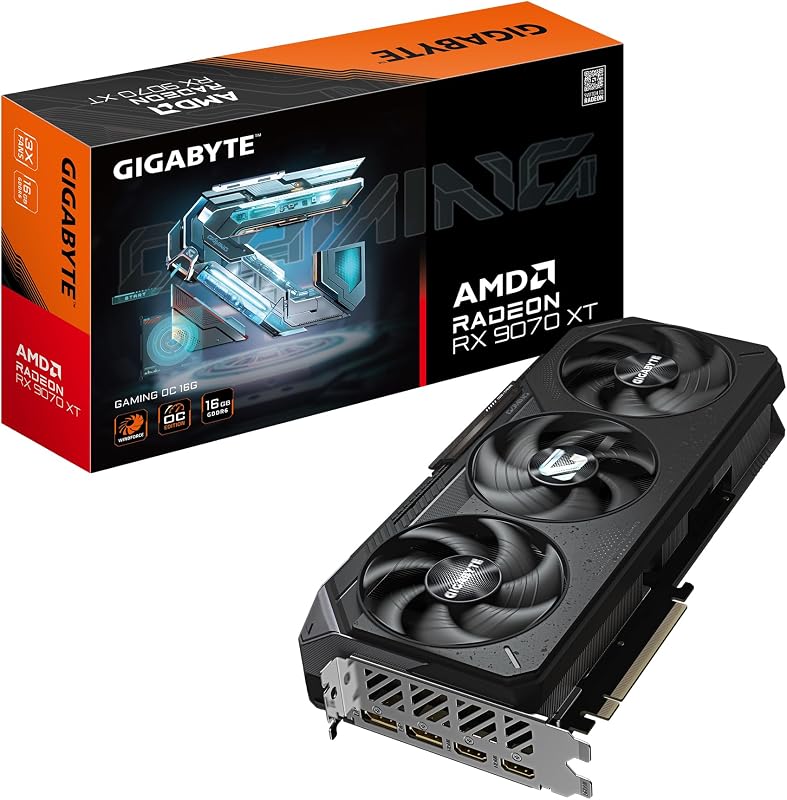
The GIGABYTE Radeon RX 9070 XT Gaming OC 16G delivers a massive 16GB GDDR6 memory configuration backed by PCIe 5.0 bus compatibility. PC builders who prefer an alternative graphics architecture with substantial onboard video memory for high-resolution rendering workloads can consider this option for their desktop rigs.
ASRock Radeon RX 9070 Challenger

The ASRock Radeon RX 9070 Challenger 16GB OC graphics card features RDNA 4 architecture with a 2520MHz boost clock, 16GB GDDR6 memory across a 256-bit bus, and a triple-fan cooling array with 0dB silent operation. Gamers seeking an alternative triple-fan configuration focused on quiet operation and robust standard rasterization may find this model well matched to their display setup.
Final Verdict
Evaluating the complete hardware package reveals that the ZOTAC RTX 5080 Solid Core OC successfully delivers on its design philosophy. By uniting NVIDIA’s Blackwell architecture with 16GB of ultra-fast 30 Gbps GDDR7 memory, it provides the computational bandwidth necessary to dominate high-refresh 4K gaming, advanced ray-tracing simulations, and neural DLSS 4 workflows. The engineering team has wisely backed this processing power with the IceStorm 3.0 cooling system, integrating a vapor chamber, composite heatpipes, and BladeLink fans that maintain disciplined acoustic and thermal levels under heavy gaming stress.
When asking is zotac rtx 5080 worth it, the answer depends entirely on your display hardware and performance targets. If you operate an ultra-high-resolution monitor, plan to leverage DisplayPort 2.1b high-bandwidth connections, and want a card built with structural durability like a metal backplate and included support bracket, this card stands out as an elite solution. While its 11.9-inch length and 2.5-slot profile require adequate chassis space, it represents an outstanding, future-ready engine for dedicated PC enthusiasts.
FAQ
Does the ZOTAC RTX 5080 Solid Core OC support DLSS 4?
Yes, the card is powered by the NVIDIA Blackwell architecture and natively supports DLSS 4 for advanced AI-driven frame rendering and image reconstruction.
What display connections are integrated onto the card?
The graphics card provides three DisplayPort 2.1b connections and one HDMI 2.1b port, supporting up to four simultaneous displays with a maximum digital resolution of 7680 x 4320.
What accessories come packaged in the product box?
Inside the box, the listing specifies that you receive the graphics card, a dedicated GPU support stand, a 3x 8-pin to 16-pin power cable adapter, a user manual, and a quick start guide.
How does IceStorm 3.0 manage acoustic noise during light desktop use?
IceStorm 3.0 features FREEZE Fan Stop technology, which completely halts the three 90mm BladeLink fans during low-load tasks, providing silent operation until GPU temperatures rise during heavy gaming.
What are the exact physical dimensions of this graphics card?
The card measures 11.9 inches in length and 2.2 inches in width, utilizing a 2.5-slot expansion profile inside desktop computer cases.
How these reviews are put together
- 938reviews published
- 2,271products with a buyer rating
- 2,222products with listed features
- 87brands covered
Every number, star and price on this site is read from the Amazon product listing. We do not run lab tests of our own, so scores here are out of 10, based on listed specifications and buyer feedback, not a verdict from a test bench. Prices change without notice; check the listing before buying.


