ASUS ROG Astral RTX 5080 Review: Overbuilt Enthusiast Power
The ASUS ROG Astral RTX 5080 represents an ambitious evolution in custom GPU engineering, bringing flagship cooling innovations to NVIDIA’s high-end Blackwell lineup. Packing a massive quad-fan thermal apparatus, a vapor chamber with a milled heatspreader, and a factory boost clock pushing to 2790 MHz, this white-themed enthusiast card is engineered to extract every drop…
By Rachel Ford
9 min read
As Amazon Associates, we earn from qualifying purchases. This means we may receive a small commission at no extra cost to you if you click through and make a purchase.
The ASUS ROG Astral RTX 5080 represents an ambitious evolution in custom GPU engineering, bringing flagship cooling innovations to NVIDIA’s high-end Blackwell lineup. Packing a massive quad-fan thermal apparatus, a vapor chamber with a milled heatspreader, and a factory boost clock pushing to 2790 MHz, this white-themed enthusiast card is engineered to extract every drop of frequency stability from its silicon without breaking a sweat. If you demand whisper-quiet acoustics, immaculate aesthetics, and class-leading thermal headroom for demanding titles, this board delivers an uncompromising premium experience.
This powerhouse suits hardware enthusiasts, high-refresh 4K gaming purists, and builders crafting high-end white-themed rigs who possess a large PC chassis capable of housing a massive card. On the other hand, builders restricted by compact mid-tower or small-form-factor cases, or those seeking standard baseline performance without paying for extreme thermal over-engineering, will be better served by smaller dual- or triple-fan options.
Thermal Architecture and Cooling Innovation
Cooling performance forms the centerpiece of the card’s entire engineering concept. Custom graphics cards frequently suffer from thermal saturation during sustained gaming sessions, but the asus rog astral 5080 addresses this directly through an unprecedented quad-fan configuration. By deploying four precision-tuned Axial-tech fans across the oversized fin stack, this arrangement increases airflow and static pressure by up to 20 percent compared to conventional triple-fan setups. The extra fan ensures air actively flows across the rear exhaust area, venting hot air smoothly through the chassis rather than allowing it to recirculate inside the shroud.
Beneath the quad-fan array sits an intensely engineered thermal interface. ASUS combines a patented vapor chamber with a finely milled heatspreader to draw heat away from the Blackwell graphics processor with remarkable speed. Rather than relying on traditional paste that can degrade or pump out over long periods of thermal cycling, the card uses a specialized phase-change GPU thermal pad. This material transitions into an optimal fluid state under operational temperatures, filling microscopic imperfections between the silicon die and the coldplate to lower temperatures and maintain long-term reliability.
The enormous 3.8-slot heatsink array provides the raw surface area needed to dissipate wattage quickly. Dense aluminum cooling fins run the entire span of the 14.1-inch card, giving the thermal module enough passive capacity that the fans can spin at modest speeds even under high rendering loads. For enthusiasts who push their hardware with unlocked frame rates, this complex cooling system ensures zero thermal throttling during extended gameplay.
Clock Speeds, Power Delivery, and Overclocking Potential
Out of the box, the ASUS ROG Astral RTX 5080 arrives with aggressive factory tuning designed to outpace reference specifications. In Default Mode, the graphics processor targets a steady 2760 MHz boost clock, while activating OC Mode through software pushes the ceiling to 2790 MHz. When combined with the high-bandwidth GDDR7 memory operating at 2790 MHz, the card delivers consistent throughput across demanding computational workloads, supported by an impressive AI processing capability rated at 1899 AI TOPS. Enthusiasts comparing high-tier hardware will find this level of clock stability echoes the engineering philosophy found on top-tier cards like the rog edition 20.
Maintaining these high frequencies requires exceptionally clean, uncompromised power delivery. ASUS equips the printed circuit board with powerful 80-amp MOSFETs that distribute electrical current smoothly and resist thermal degradation under intense stress. This power stage minimizes electrical ripple and provides the headroom necessary for sustained boost clocks, giving manual overclockers the stability needed to explore the silicon’s outer limits without encountering sudden voltage drops.
Durability under extreme conditions is reinforced by a specialized protective PCB coating. This invisible shield seals vulnerable electrical traces against external hazards including ambient moisture, dust accumulation, and extreme temperatures. Whether you operate your system in humid environments or use sub-ambient cooling methods during benchmark sessions, the protective layer guards against short circuits and extends the life of the board’s core electrical components.
Gaming Performance and Benchmark Expectations
Targeted squarely at high-refresh gaming, this graphics card handles cutting-edge gaming engines with poise. The integration of 16 GB of lightning-fast GDDR7 VRAM ensures ample buffer capacity for high-resolution texture packs, ray tracing structures, and geometry caches. With native support for display resolutions up to 7680 x 4320, the GPU is fully equipped to drive immersive ultra-wide setups and true 4K gaming monitors without hitching or memory constraints.
The Blackwell architecture brings native architectural enhancements along with DLSS 4 support. In modern titles utilizing intensive path tracing, the dedicated hardware accelerates neural rendering pipelines to double or triple frame rates while maintaining crisp image clarity. When running demanding visual benchmarks, the combination of elevated factory clocks and unrestricted thermal headroom translates to flat frame-time graphs and an absence of micro-stutters that can plague thermally constrained boards.
Competitive players and cinematic adventure enthusiasts alike benefit from the sheer throughput of the PCI-Express x16 interface and modern display standards. With three DisplayPort 2.1b connections and two native HDMI 2.1b ports, multi-monitor productivity setups and high-refresh 4K displays operate with full color depth and refresh frequencies without requiring display stream compression workarounds.
Acoustic Profile and Operating Noise Levels
A frequent downside of massive graphics cards is intrusive fan noise, but the thermal volume of this card works directly to its acoustic advantage. Because the 3.8-slot heatsink and vapor chamber dissipate enormous amounts of heat passively, the four Axial-tech fans do not need to ramp up to aggressive RPM tiers to keep core temperatures in check. Under moderate gaming loads, the fans rotate at relaxed speeds, generating a gentle hum that blends into ambient room noise.
The airflow geometry created by the quad-fan layout prevents acoustic turbulence. Rather than pushing air against solid obstructions, the fan blades channel air cleanly through the fin stacks and out the ventilated frame. The listing does not specify decibel measurements, but the expanded surface area and multi-fan air distribution naturally reduce the need for high-speed fan cycles that produce irritating high-pitched whines.
During idle and low-load scenarios such as web browsing, document editing, or streaming media, the card maintains complete silence. The fans engage smoothly only when thermal thresholds demand active dissipation, ensuring your desktop environment remains peaceful when you are not actively gaming.
Form Factor, Structural Rigidity, and Build Quality
Aesthetics and structural stability are vital considerations for a component of this scale. Finished in a striking white theme, the card stands out in showcase builds with its clean, industrial lines. However, measuring 14.1 inches in length and 5.9 inches in width while occupying nearly four full expansion slots, this is a massive piece of hardware that demands careful case planning and verification of chassis clearance before purchase, much like when planning builds around large enclosures designed for cards such as the asus tuf 5090.
To ensure a board of this mass does not bend or damage the motherboard slot over time, ASUS incorporated extensive structural bracing. The card features a full metal diecast shroud, a rigid frame backplate, and a reinforced rear I/O bracket that together create an unyielding exoskeleton. This reinforced cage prevents PCB flexing and distributes mechanical load evenly along the chassis mounting points.
Further protecting the internal silicon is ASUS GPU Guard technology. This structural feature anchors the four corners of the GPU die securely to the mounting bracket, preventing micro-fractures in solder balls during shipping, system relocation, or heavy thermal expansion. The included metal GPU bracket provides an additional physical pillar inside the PC case, eliminating GPU sag completely and ensuring long-term physical integrity.
ASUS ROG Astral RTX 5080 Pros and Cons
Pros
- Quad-fan design boosts airflow and pressure by 20%
- Patented vapor chamber with milled heatspreader
- Phase-change GPU thermal pad ensures optimal transfer
- Robust 80-amp MOSFETs and protective PCB coating
- Five native video outputs including DisplayPort 2.1b
- Rigid diecast frame with GPU Guard bracket
Cons
- Massive 3.8-slot thickness limits case compatibility
- Substantial 14.1-inch length restricts small enclosures
- Heavy multi-metal frame demands dedicated bracket support
Check ASUS ROG Astral RTX 5080 on Amazon
Who Should Buy the ASUS ROG Astral RTX 5080
Buy It If
- You own a spacious full-tower or large mid-tower chassis that easily accommodates a 14.1-inch, 3.8-slot graphics card.
- You are assembling a premium white-themed battlestation and want hardware that matches your aesthetic vision without sacrificing cooling performance.
- You play modern graphically demanding titles at 4K resolution and want high sustained boost clocks backed by robust power delivery.
- You demand whisper-quiet acoustics achieved through an overbuilt quad-fan vapor chamber cooling design.
Skip It If
- You build inside a compact microATX or mini-ITX enclosure where a 3.8-slot thickness and 14.1-inch length will physically block intake fans or motherboard headers.
- You prefer a minimalist black aesthetic that blends inconspicuously into a standard chassis interior.
- You only require baseline reference performance and prefer a lighter, standard-sized triple-fan graphics card.
ASUS ROG Astral RTX 5080 Alternatives Worth a Look
While the Astral delivers an exceptional flagship experience, alternative graphics cards cater to builders with different space constraints, display goals, or platform preferences.
GIGABYTE Radeon RX 9070 XT
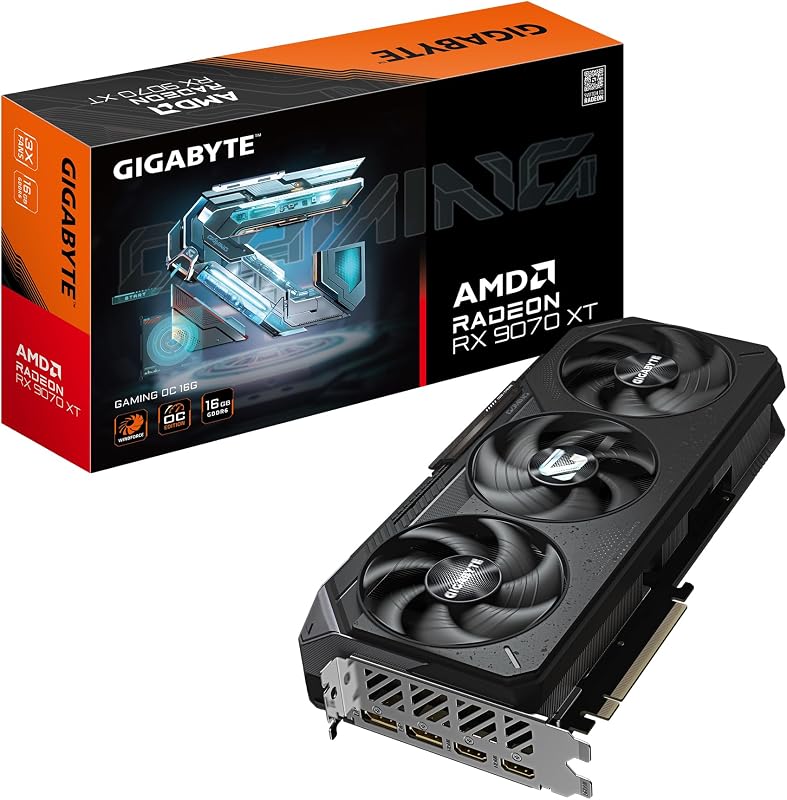
The GIGABYTE Radeon RX 9070 XT provides 16GB of GDDR6 memory on a PCIe 5.0 interface. Gamers who prefer an AMD-based graphics ecosystem with robust rasterization power and a traditional form factor may favor this card over the oversized quad-fan design of the Astral.
PCIe 5.0 ASUS TUF Gaming GeForce RTX 5080
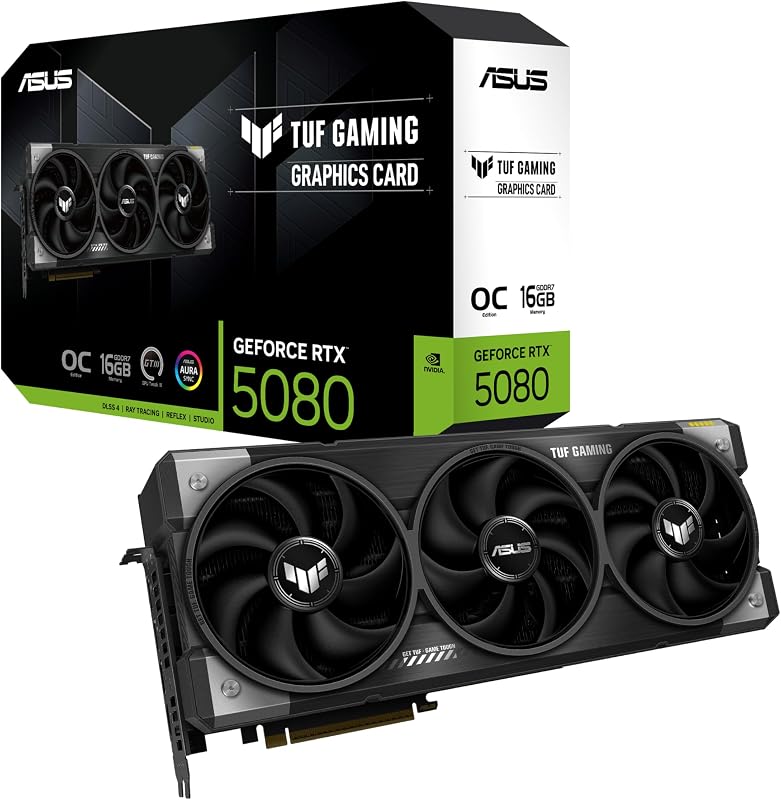
The PCIe 5.0 ASUS TUF Gaming GeForce RTX 5080 OC Edition features military-grade components, a protective PCB coating, and Axial-tech fans in a slightly more compact 3.6-slot profile. It is an excellent alternative for builders who want Blackwell performance and rugged reliability in a darker, industrial aesthetic.
ASRock Radeon RX 9070 Challenger

The ASRock Radeon RX 9070 Challenger offers RDNA 4 architecture, a 2520 MHz boost clock, 16GB GDDR6 memory across a 256-bit bus, and triple fans with 0dB silent operation. Builders seeking a streamlined, triple-fan card with LED indicators will appreciate its more approachable dimensions.
Final Verdict
The ASUS ROG Astral RTX 5080 establishes a new standard for air-cooled graphics cards. By integrating four Axial-tech fans, a patented vapor chamber, a phase-change thermal pad, and heavy-duty 80-amp power stages, ASUS has eliminated thermal bottlenecks entirely. The card sustains its factory-overclocked 2790 MHz boost profile effortlessly while maintaining remarkably low noise levels and ice-cold operating temperatures.
Its massive physical dimensions and distinct white diecast chassis mean it is deliberately crafted for enthusiast showcases rather than compact, budget-oriented builds. If your chassis possesses the clearance to house this 3.8-slot marvel and you demand elite build quality, superior structural bracing, and flawless 4K gaming stability, the ROG Astral stands as one of the most capable custom graphics cards available.
FAQ
How does the quad-fan cooling system on the ASUS ROG Astral RTX 5080 work?
The cooling solution uses four specialized Axial-tech fans paired with an oversized 3.8-slot heatsink. This four-fan layout boosts total airflow and static pressure by up to 20 percent, channeling cool air through the dense fin array and patented vapor chamber to dissipate heat rapidly.
What display outputs are available on the ASUS ROG Astral RTX 5080?
The card features five native display outputs: two native HDMI 2.1b ports and three native DisplayPort 2.1b connections. This diverse layout supports high-refresh multi-monitor arrays and ultra-high-definition displays up to 7680 x 4320 resolution.
How large is the ASUS ROG Astral RTX 5080, and what case size is required?
The card measures 14.1 inches long by 5.9 inches wide and occupies 3.8 expansion slots. Due to its length and thickness, builders should use a spacious mid-tower or full-tower desktop chassis with ample clearance past front-mounted radiators.
What are the factory clock speeds of this card?
The card operates at a default boost clock of 2760 MHz, while the selectable OC mode pushes the boost clock to 2790 MHz. The 16 GB of GDDR7 memory also operates at a rated clock speed of 2790 MHz.
What structural protections prevent the card from sagging?
The card is built with a full metal diecast shroud, a reinforced frame backplate, and a rear I/O bracket that brace the PCB. It also incorporates GPU Guard technology to secure the four corners of the graphics processor and comes with a dedicated GPU bracket for mounting stability.
How these reviews are put together
- 556reviews published
- 2,271products with a buyer rating
- 2,222products with listed features
- 87brands covered
Every number, star and price on this site is read from the Amazon product listing. We do not run lab tests of our own, so scores here are out of 10, based on listed specifications and buyer feedback, not a verdict from a test bench. Prices change without notice; check the listing before buying.


