Western Digital WD Red Plus 12TB HDD: Performance & Storage Deep Dive
The WD Red Plus 12TB is a purpose-built 3.5-inch internal mechanical hard drive engineered to handle heavy multi-user workloads, massive personal archives, and demanding local streaming demands. Operating at a brisk 7200 RPM spindle speed with a massive 512 MB cache buffer, this drive bridges the gap between everyday desktop platters and specialized enterprise infrastructure.…
By Rachel Ford
11 min read
As Amazon Associates, we earn from qualifying purchases. This means we may receive a small commission at no extra cost to you if you click through and make a purchase.
The WD Red Plus 12TB is a purpose-built 3.5-inch internal mechanical hard drive engineered to handle heavy multi-user workloads, massive personal archives, and demanding local streaming demands. Operating at a brisk 7200 RPM spindle speed with a massive 512 MB cache buffer, this drive bridges the gap between everyday desktop platters and specialized enterprise infrastructure. Delivering sustained transfer speeds rated up to 260 MB/s alongside Conventional Magnetic Recording technology, it provides high-density reliability that ensures steady data integrity across continuous operation cycles.
This high-capacity mechanical drive is specifically tailored for media archivists, enthusiast homelab builders, and multi-bay networked storage users who require resilient local backups and expansive Plex libraries. It serves as an ideal bulk repository for secondary PC game installations where raw capacity per bay outweighs the microsecond access times of solid-state storage. However, builders who require whisper-quiet desktop environments without mechanical vibrations or those hunting for maximum operating bandwidth across high-speed flash arrays should consider pairing mechanical drives with solid-state options like the wd red sn700 or looking directly toward dedicated solid-state architectures.
Transfer Speeds and 7200 RPM Performance
Mechanical drive throughput is dictated primarily by platter density and spindle rotation, and the wd red 12tb 7200 rpm architecture maximizes both variables. Unlike standard 5400 RPM class drives that prioritize lower power draw at the expense of transfer velocity, this unit rotates at a full 7200 RPM. This higher rotational velocity brings measurable advantages to large sequential file transfers, yielding a rated maximum sustained internal read speed of 260 MB/s. Backed by a generous 512 MB cache buffer, the drive effectively smooths out write bursts and mitigates input/output bottlenecks when moving multi-gigabyte files across a local network.
Sustained sequential throughput represents the core metric for evaluating wd120efgx performance across everyday real-world duties. The drive listing also references an internal media speed of up to 490 MB/s, reflecting the high internal linear bit density achieved on the magnetic platters before SATA interface translation. When ingesting raw 4K camera footage, running scheduled system disk images, or moving massive compressed archives, the drive saturates a standard 1GbE network connection completely and can push a 2.5GbE interface near its practical mechanical throughput limits during sequential transfers.
The underlying Conventional Magnetic Recording architecture serves as a foundational pillar of this model’s performance profile. Because the wd red plus 12tb cmr platform writes data tracks parallel to one another rather than overlapping them in shingles, write cycles remain entirely predictable. Sustained writes do not drop to single-digit megabytes per second during extended transfers, avoiding the common throughput cliff that plagues alternative shingled magnetic recording designs during parity calculations and heavy sequential writes.
NAS Integration and Multi-Drive Reliability
Deploying drives into tight multi-bay chassis introduces mechanical challenges that isolated desktop hard drives are never designed to survive. The wd red 12tb nas storage platform incorporates proprietary NASware firmware, specifically calibrated to balance drive acoustics, thermal dissipation, and rotational vibration across enclosures housing up to 8 drive bays. This specialized firmware integrates advanced error recovery controls, preventing the drive from prematurely dropping out of a hardware or software RAID pool when encountering brief read verification delays.
System architects planning mission-critical storage pools will appreciate the drive’s support for complex file systems like ZFS and Btrfs. Rebuilding a degraded multi-terabyte RAID array places immense mechanical stress on every drive in the enclosure. With its 180 TB/year workload rating, the unit provides the necessary operational overhead for intensive parity reconstructions, recurring data scrubs, and automated integrity validation without violating manufacturer duty cycle specifications. Enthusiasts looking for even higher density storage architectures across larger deployment pools can review enterprise alternatives such as the wd red 18tb to scale their arrays further.
Durability specifications from the manufacturer confirm a design intended strictly for continuous 24×7 operational environments. The physical architecture includes internal dust-resistant protection to help safeguard sensitive mechanical components over years of continuous air movement inside actively ventilated chassis. Built and validated to operate without unforced idle spin-downs, the drive ensures round-the-clock availability for connected client devices, background synchronization daemons, and remote data management tasks.
Plex and Home Media Server Capabilities
Media curation represents one of the primary use cases for massive capacity hard drives, and configuring a wd red 12tb for media server duties provides ample headroom for burgeoning digital libraries. A single 12TB volume holds hundreds of full-quality uncompressed 4K Blu-ray remuxes, thousands of standard 1080p video files, and extensive lossless music collections. Having this massive repository accessible on a continuous basis ensures your household streaming server remains fully stocked without requiring frequent file deletion or external juggling.
Deploying the wd red 12tb for plex streaming setups allows the drive to leverage its 260 MB/s sequential read capability to easily deliver simultaneous high-bitrate video streams. While an uncompressed 4K HDR stream demands anywhere from 50 to 125 Mbps, the SATA 6.0 Gb/s interface and generous 512 MB internal cache handle multiple concurrent read streams to separate local devices without stuttering or playback buffering. Even when automated maintenance tasks or background file metadata indexing run in the background, read commands for active media playback remain prioritized and smooth.
For collectors whose libraries expand beyond basic single-drive enclosures, multi-disk arrays built with these CMR platters ensure predictable playback under load. Systems serving multi-user households benefit from the drive’s firmware optimizations that prevent playback drops during simultaneous streaming and background torrent or Usenet ingestion. If your streaming requirements eventually require massive commercial-grade rack arrays, dedicated high-bay options such as the western digital red pro 18tb offer pathways for expanding beyond the standard 8-bay limits of the Plus series.
Game Storage, Acoustics, and Workload Limits
Modern video game installations frequently exceed 100GB to 150GB per title, making the wd red 12tb game storage application a practical strategy for PC gaming enthusiasts. While high-speed solid-state drives are mandatory for modern game execution to prevent traversal stutter and long loading screens, this 12TB mechanical volume functions superbly as a local archive repository. Games can be easily stored locally, updated automatically via background clients, and transferred to primary SSDs over the internal SATA bus in a fraction of the time required to redownload them over standard broadband connections.
Acoustic performance is an important factor when deciding where to place a high-capacity drive, especially for desktop PC builds and living room server setups. Regarding the wd red 12tb noise level, the manufacturer listing does not specify decibel ratings; however, the reality of a 7200 RPM 3.5-inch drive must be taken into account. Mechanical platters spinning at high speed alongside rapid actuator arm sweeps inherently produce audible seek chatter and low-frequency resonance. While NASware firmware helps mitigate erratic head movements, users placing this drive inside an uninsulated desktop case directly on a desk will clearly hear mechanical seek chatter during heavy random access tasks.
Workload duty cycles are rated at 180 TB/year, calculated based on the total annualized volume of user data transferred to or from the hard drive across 8,760 power-on hours. For personal gaming storage, media streaming, and routine system backups, this 180 TB limit provides extensive headroom. Unless the drive is deployed into an intense enterprise data center running unrelenting multi-tenant write cycles, everyday enthusiast activities will comfortably remain within the manufacturer’s operational threshold.
Hardware Specifications and Build Architecture
A technical inspection of the wd red 12tb specs highlights an internal design optimized specifically for balance between performance and thermal resilience. Built within a standard 3.5-inch form factor, the drive connects via standard SATA 6.0 Gb/s cabling and features Western Digital’s distinctive red labeling on its chassis. While the listing notes that enclosure material information is not available, the drive adheres to standard internal desktop and server mounting hole spacing, ensuring seamless installation across toolless server caddies, desktop hard drive cages, and external multi-bay docks.
The combination of a 512 MB DRAM cache and an advanced dual-plane balance control mechanism ensures structural reliability inside dense chassis environments. In an 8-bay chassis, vibrations generated by neighboring hard drives can induce read/write tracking errors if platters are not properly stabilized. This model’s internal vibration mitigation features preserve mechanical tracking accuracy, preventing performance throttling when all bays are actively operating under full load.
Electrical and interface compatibility is straightforward, utilizing standard SATA data and 15-pin SATA power connectors. The drive is designated for desktop and business NAS systems, providing immediate interoperability with Windows, Linux, TrueNAS, and dedicated NAS operating environments. With dust-resistant hardware sealing and a 3-year limited warranty, the drive’s physical architecture delivers long-term durability for users seeking substantial, non-volatile capacity.
WD Red Plus 12TB Pros and Cons
Pros
- High 7200 RPM spindle speed with 260 MB/s transfers
- Generous 512 MB cache memory buffer
- Reliable CMR technology prevents write slowdowns
- NASware firmware supports up to 8-bay enclosures
- Substantial 180 TB per year workload rating
- Tested for continuous 24×7 operational reliability
Cons
- Audible seek noise inherent to 7200 RPM operation
- Listing does not specify decibel ratings or enclosure material
- Limited to 8-bay enclosures rather than enterprise racks
Check WD Red Plus 12TB on Amazon
Who Should Buy the WD Red Plus 12TB
Buy It If
- You manage a multi-bay home server or small business NAS holding up to 8 drives that requires 24×7 operational reliability.
- You maintain a massive personal Plex media collection or multi-terabyte raw video archive demanding high-speed sequential streaming.
- You need a massive, reliable CMR storage pool for local PC game hoarding, automated system backups, and periodic disk cloning.
- You require fast 7200 RPM mechanical throughput and a 512 MB cache buffer to fully maximize local network transfer speeds.
Skip It If
- You require near-silent acoustic operation directly inside an ultra-quiet bedroom or office desktop PC.
- You intend to execute modern AAA games directly from the drive rather than using it as a secondary archival repository.
- You manage a large-scale enterprise server installation requiring chassis expansion beyond 8 drive bays.
WD Red Plus 12TB Alternatives Worth a Look
If the capacity, operational profile, or mechanical specifications of this 12TB model do not entirely align with your specific storage architecture, several alternative internal drives provide varied trade-offs in capacity, cost efficiency, and intended platform use.
Seagate 8TB BarraCuda Internal Hard Drive
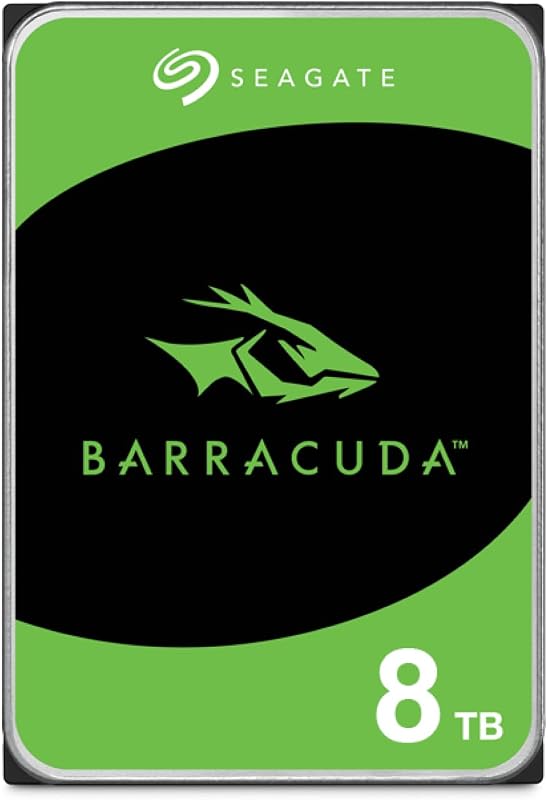
The Desktop HDD for everyday PC storage, gaming, and computing (ST8000DM004) provides 8TB of capacity over a SATA 6 Gb/s interface. Backed by a 2-year warranty and 2-year Rescue Data Recovery Services, this drive is engineered primarily for everyday desktop computer storage rather than multi-drive networked environments. Shoppers who need basic bulk desktop PC storage without paying for multi-bay NAS firmware will find this a suitable desktop-oriented alternative.
Seagate 8TB IronWolf Internal NAS Hard Drive
The 24 7 NAS-optimized HDD. AgileArray drive (ST8000VNZ04) is built specifically for 24×7 multi-bay networked systems. Featuring AgileArray firmware, All-CMR recording technology, rotational vibration sensors, a 180TB/year workload limit, a 3-year warranty, and 3-year Rescue services, this 8TB drive directly competes with NAS-class platforms. It represents a compelling option for builders who want dedicated multi-bay NAS features in a slightly smaller 8TB capacity point.

Seagate BarraCuda 4TB Internal Hard Drive
For smaller desktop computing setups, the Seagate BarraCuda 4TB Internal Hard Drive (ST4000DMZ04/DM004) provides an entry-level capacity solution. Operating at a 5400 RPM spindle speed with a 256MB cache in a standard 3.5-inch SATA form factor, this drive prioritizes lower power draw and standard desktop operation. It suits casual PC users looking to add a basic secondary hard drive for documents, family photos, and modest media collections without needing enterprise-grade workload ratings.

Final Verdict
When assessing whether the storage investment is justified, evaluating if the drive meets your workflow needs depends on capacity demands and network infrastructure. The drive delivers an exceptional technical package for enthusiasts, pairing a massive 12TB capacity and Conventional Magnetic Recording with a fast 7200 RPM rotational velocity and a 512 MB cache buffer. Its ability to maintain sustained transfer rates up to 260 MB/s ensures that heavy local file transfers and high-bitrate multi-stream media playback occur smoothly without typical mechanical bottlenecks.
While the audible head chatter inherent to 7200 RPM mechanical drives makes it less ideal for silent desktop builds, it excels inside multi-bay NAS enclosures, home server racks, and secondary backup chassis. Supported by NASware firmware, up to 8-bay multi-drive vibration mitigation, an annualized 180 TB workload rating, and a 3-year limited warranty, this model stands out as a dependable, high-performance mechanical storage solution for serious media collectors and data hoarders alike.
FAQ
Is the WD Red Plus 12TB a CMR or SMR hard drive?
The drive uses Conventional Magnetic Recording (CMR) technology. Unlike Shingled Magnetic Recording (SMR) drives, CMR platters write data tracks side-by-side without overlapping, ensuring consistent write speeds and preventing severe performance drops during intensive sustained write tasks and RAID rebuilds.
What is the rotational speed and cache size of this drive?
This 12TB model operates at a rotational speed of 7200 RPM and features an installed cache memory buffer of 512 MB, allowing it to sustain read and write transfer rates of up to 260 MB/s across its SATA 6.0 Gb/s connection.
Can I use the WD Red Plus 12TB for PC gaming?
Yes, the drive works effectively as a high-capacity game storage archive for PC setups. While modern games benefit from being executed directly from high-speed SSDs to avoid loading delays, this 12TB drive is ideal for storing large game libraries and transferring game files locally to an SSD when needed.
What is the noise level of the WD Red Plus 12TB?
The listing does not specify exact decibel ratings for operating or idle sound levels. However, because it spins at 7200 RPM and features multiple high-density platters, users should expect audible mechanical seek chatter and low vibrational hum during heavy file access, making it better suited for server enclosures or isolated desktop towers than silent desk environments.
How many drive bays does this model support in a single enclosure?
The drive is specifically engineered and tested with NASware firmware to support enclosures with up to 8 drive bays. Systems expanding into larger commercial rackmount enclosures beyond 8 bays typically require enterprise-class drives designed for higher bay counts.
How these reviews are put together
- 203reviews published
- 2,271products with a buyer rating
- 2,222products with listed features
- 87brands covered
Every number, star and price on this site is read from the Amazon product listing. We do not run lab tests of our own, so a score here is the average rating left by buyers, not a verdict from a test bench. Prices change without notice; check the listing before buying.


