ASRock Radeon RX 9070 XT Challenger 16GB: Complete Gaming Breakdown
The ASRock RX 9070 XT Challenger 16GB arrives as an ambitious performance graphics card engineered around AMD’s RDNA 4 architecture, offering enthusiasts a substantial leap in rendering throughput and thermal control. Designed to satisfy gamers demanding uncompromising frame rates at extreme resolutions, our verdict is clear: this graphics card stands out as a formidable powerhouse…
By Rachel Ford
8 min read
As Amazon Associates, we earn from qualifying purchases. This means we may receive a small commission at no extra cost to you if you click through and make a purchase.
The ASRock RX 9070 XT Challenger 16GB arrives as an ambitious performance graphics card engineered around AMD’s RDNA 4 architecture, offering enthusiasts a substantial leap in rendering throughput and thermal control. Designed to satisfy gamers demanding uncompromising frame rates at extreme resolutions, our verdict is clear: this graphics card stands out as a formidable powerhouse that combines blazing clock frequencies with advanced ray tracing hardware to deliver exceptional high-framerate gaming.
This card directly targets enthusiast PC gamers who demand fluid visuals at 4K resolution, content creators who require a sizable 16GB video memory buffer, and system builders prioritizing modern platform connectivity. Those who want to compare baseline configurations can examine our look at the amd rx 9070 xt 16gb landscape, but shoppers working with compact small-form-factor enclosures or lower-wattage power supplies will find this substantial triple-fan card unsuitable for space-constrained or entry-level setups.
RDNA 4 Architecture and Processing Frequencies
Analyzing the core 9070 xt 16gb specs highlights AMD’s architectural refinement in this generation, centering on 64 dedicated compute units built to maximize compute density. The card integrates second-generation AI accelerators alongside third-generation ray tracing hardware, allowing it to process modern visual workloads far more efficiently than older architectures. By streamlining geometry pipelines and computational pathways, RDNA 4 provides a stable foundation for demanding game engines that lean heavily on shader calculations and concurrent compute pipelines.
Frequency management plays a pivotal role in overall responsiveness, and this model delivers an aggressive rx 9070 xt boost clock speed reaching up to 2970 MHz right out of the box. Maintaining such an elevated engine frequency ensures that shader execution remains rapid during demanding gaming scenes, preventing stuttering during intense frame transitions. Enthusiasts evaluating standard performance tiers can also cross-reference our breakdown of the rx 9070 16 gb to see how clock tuning impacts gaming throughput.
When measuring rdna 4 rx 9070 xt performance against intense computational demands, the combination of 64 compute units and high clock frequencies translates into fluid rendering speeds. The dedicated architecture ensures that graphics workloads maintain high baseline framerates, while the 2970 MHz memory clock rating and structured caching pipelines sustain continuous data throughput across complex, visually dense gaming environments.
High-Resolution Gaming and Ray Tracing Capabilities
Deploying the 9070 xt 16gb for 4k gaming demonstrates the practical advantages of pairing a broad 256-bit memory bus with a generous 16GB GDDR6 memory configuration. Modern AAA titles feature high-resolution textures, vast geometry meshes, and uncompressed asset streams that rapidly choke graphics cards with narrower interfaces. With 16GB of onboard memory, the card maintains sufficient headroom to eliminate memory-swapping bottlenecks, ensuring sustained frametimes across extreme native resolutions up to 7680×4320 pixels.
Ray tracing has historically challenged graphics hardware, but the inclusion of 3rd Gen Ray Tracing accelerators provides noticeable gains in rx 9070 xt ray tracing gaming. These dedicated hardware blocks accelerate BVH traversal and ray-box intersections, offloading compute strain from general shader units. For readers interested in custom cooling variants handling heavy ray tracing workloads, our review of the sapphire nitro radeon rx 9070 xt provides additional perspective on enthusiast board designs.
Beyond lighting calculations, the 2nd Gen AI accelerators built into the silicon play an increasingly prominent role in current rendering pipelines. These specialized matrix engines enhance frame generation and machine-learning upscaling algorithms, preserving crisp geometric detail and sharp edge clarity without imposing severe performance penalties at 4K. The result is a balanced visual experience that unifies photorealistic lighting with playable, high-refresh gameplay.
Challenger Thermal Design and Acoustic Operation
Controlling heat dissipation across high-frequency components requires substantial hardware, and the custom asrock challenger 9070 xt cooling solution is engineered specifically to manage demanding thermal profiles. The cooler incorporates a triple-fan setup utilizing custom Striped Axial Fan technology. These specialized fan blades feature patterned stripes on each fin, engineered to channel airflow directly downward through the aluminum fin stack, maximizing convective heat transfer while minimizing turbulence and wind shear noise.
Acoustic discipline is further reinforced through integrated 0dB silent cooling technology. When the system operates under routine desktop conditions, such as media playback, general office productivity, or web browsing, the cooling fans power down completely. This silent idle behavior prevents needless mechanical wear, eliminates dust accumulation during low-load scenarios, and ensures zero operating noise until internal temperatures cross the designated thermal threshold during demanding gaming sessions.
Structural integrity and supplemental cooling are augmented by a sturdy metal backplate spanning the full length of the card. In addition to shielding delicate surface-mount components on the reverse side of the printed circuit board, the metal backplate absorbs and disperses residual thermal energy. This rigid plate also counteracts graphics card sag, ensuring that the substantial triple-fan assembly remains properly seated in the motherboard expansion slot throughout long-term operational use.
Next-Gen Connectivity and System Requirements
Capitalizing on modern platform features, the card integrates full rx 9070 xt pcie 5.0 capabilities to maximize system interface throughput. Operating over a full PCI Express 5.0 x16 connection, the card doubles the potential bidirectional bandwidth compared to PCIe 4.0 motherboards. While fully backward compatible with older PCIe standard slots, pairing this graphics card with a PCIe 5.0-ready motherboard ensures future-ready data streaming for direct-storage gaming and heavy asset streaming.
Display connectivity is equally forward-looking, boasting three DisplayPort 2.1a connectors and one HDMI 2.1b output. These high-bandwidth video interfaces allow enthusiasts to drive cutting-edge gaming displays at high refresh rates in 4K resolution and up to 8K resolution at 7680 x 4320 pixels without color subsampling. Whether configuring a multi-monitor productivity workspace or connecting to an enthusiast 4K OLED display, the output array delivers exceptional display flexibility.
Power delivery requires proper planning before installation. The listing notes an 800W power recommendation, underscoring the necessity of a robust power supply unit to handle transient spikes and sustained heavy gaming sessions. Gamers planning more modest desktop builds or prioritizing alternative form factors may want to read our analysis of the rx 9060 xt 16gb white to compare physical dimensions and power expectations.
ASRock RX 9070 XT Challenger 16GB Pros and Cons
Pros
- High 2970 MHz factory boost clock speed
- Spacious 16GB GDDR6 memory on 256-bit bus
- Triple Striped Axial fans with 0dB silent mode
- Next-generation PCIe 5.0 system bus interface
- Three DisplayPort 2.1a and one HDMI 2.1b ports
Cons
- Requires a heavy-duty 800W power supply
- Triple-fan length unsuitable for compact SFF builds
- Uses GDDR6 memory rather than newer GDDR7
Check ASRock RX 9070 XT Challenger 16GB on Amazon
Who Should Buy the ASRock RX 9070 XT Challenger 16GB
Deciding whether the 9070 xt 16gb is worth it comes down to your target display resolution, chassis dimensions, and power infrastructure. This card is engineered specifically for enthusiasts who prioritize uncompromising rasterization speeds and cutting-edge video output standards.
Buy It If
- You want fluid 4K gaming performance backed by 16GB of high-speed GDDR6 memory on a 256-bit bus.
- You plan to use modern DisplayPort 2.1a or HDMI 2.1b displays capable of high refresh rates or 8K resolution.
- You own a modern motherboard with PCIe 5.0 support and an 800W or higher power supply.
- You value quiet computing during desktop tasks, made possible by the 0dB silent cooling fan technology.
Skip It If
- Your PC chassis cannot accommodate a large, triple-fan graphics card assembly.
- Your existing system operates with a lower-wattage power supply below the card’s 800W specification.
- You play strictly lightweight esports titles at 1080p where an enthusiast 16GB card exceeds your performance needs.
ASRock RX 9070 XT Challenger 16GB Alternatives Worth a Look
If the physical dimensions, power demands, or platform specifics of this card do not match your build criteria, several compelling alternatives provide different configurations from competing hardware lineups.
ASUS SFF-Ready Prime NVIDIA GeForce RTX 5070

The ASUS SFF-Ready Prime NVIDIA GeForce card features 12GB of GDDR7 memory, PCIe 5.0 connectivity, and a more compact 2.5-slot physical design equipped with Axial-tech fans and Dual BIOS. It also comes backed by a 3-year warranty.
Gamers assembling compact, small-form-factor desktop PCs who need guaranteed chassis compatibility should select this card over the ASRock Challenger, trading 4GB of video memory for smaller external dimensions and newer GDDR7 memory technology.
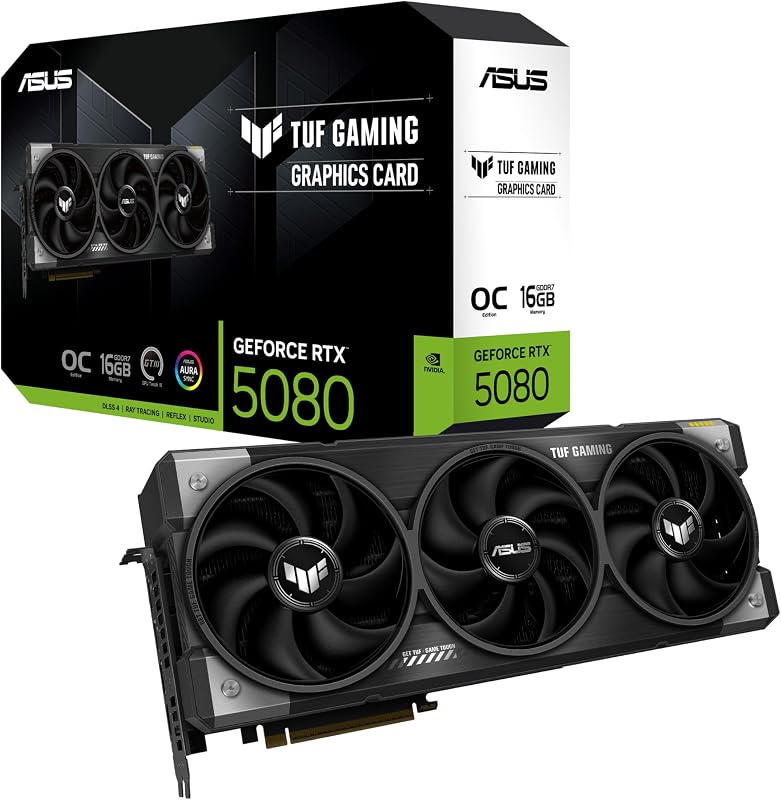
ASUS TUF Gaming GeForce RTX 5080
Built with heavy-duty construction, the PCIe 5.0 ASUS TUF Gaming GeForce RTX 5080 16GB GDDR7 OC Edition graphics card utilizes a large 3.6-slot footprint with military-grade components, protective PCB coating, and Axial-tech cooling fans.
Enthusiasts seeking heavy-duty industrial build components, ultra-thick 3.6-slot cooling assemblies, and next-generation GDDR7 memory will prefer this card if their full-tower PC case can accommodate its massive physical profile.
GIGABYTE GeForce RTX 5080 Gaming OC

The GIGABYTE GeForce RTX 5080 Gaming OC 16G card features a 256-bit memory bus equipped with 16GB of GDDR7 memory, driven by GIGABYTE’s proprietary WINDFORCE cooling system.
Builders who want the combination of a 16GB 256-bit configuration with GDDR7 memory and an alternate triple-fan cooling philosophy should evaluate this model as a direct performance competitor.
Final Verdict
The ASRock RX 9070 XT Challenger 16GB successfully establishes itself as a commanding graphics card for modern enthusiasts. By uniting AMD’s RDNA 4 architecture, 64 compute units, and a remarkable 2970 MHz boost clock speed with a roomy 16GB GDDR6 memory buffer, it effortlessly handles the rigorous computational loads of high-framerate 4K gaming and high-fidelity ray tracing.
Combined with its effective Striped Axial triple-fan cooler, silent 0dB idle profile, PCIe 5.0 support, and future-ready DisplayPort 2.1a connectivity, this card provides an exceptional blend of performance and engineering for serious gaming rigs. As long as your PC case has room for the card and your power supply meets the 800W recommendation, the ASRock Challenger delivers an uncompromising upgrade for modern gaming.
FAQ
Does the ASRock RX 9070 XT Challenger 16GB support ray tracing?
Yes, the card features AMD’s 3rd Gen Ray Tracing accelerators integrated into its 64 RDNA 4 compute units, allowing it to accelerate hardware ray tracing calculations and provide realistic dynamic lighting in supported titles.
What power supply is recommended for this graphics card?
The listing specifies an 800W power supply requirement to ensure stable operation and accommodate peak power draw during intensive gaming and compute tasks.
What display outputs are available on the card?
The card provides three DisplayPort 2.1a outputs and one HDMI 2.1b output, supporting high-refresh monitors and ultra-high resolutions up to 7680 x 4320 pixels.
How does the 0dB silent cooling feature work?
The card’s 0dB silent cooling feature stops the triple cooling fans entirely when temperatures remain low during light tasks like web browsing or office work, resuming active fan rotation only when gaming loads raise thermal levels.
What items are included in the box?
The product package contains one ASRock RX 9070 XT Challenger graphics card and one quick installation guide to assist with hardware setup.
Does the card support PCIe 4.0 motherboards?
Yes, while the card is built with next-generation PCI Express 5.0 capabilities, PCI Express interfaces are backward compatible, allowing the card to operate on motherboards equipped with PCIe 4.0 or older slots.
How these reviews are put together
- 203reviews published
- 2,271products with a buyer rating
- 2,222products with listed features
- 87brands covered
Every number, star and price on this site is read from the Amazon product listing. We do not run lab tests of our own, so a score here is the average rating left by buyers, not a verdict from a test bench. Prices change without notice; check the listing before buying.


