Gigabyte GeForce RTX 5060 Ti 16GB WINDFORCE OC Analysis: Next-Gen Midrange Gaming
The Gigabyte RTX 5060 Ti 16GB WINDFORCE OC graphics card (model GV-N506TWF2OC-16GD) is a dedicated desktop GPU engineered around NVIDIA’s cutting-edge Blackwell architecture. Equipped with an expansive 16GB GDDR7 frame buffer running across a 128-bit memory bus, a boosted 2587 MHz core frequency, and modern PCIe 5.0 interface support, this graphics card provides a compact,…
By Rachel Ford
8 min read
As Amazon Associates, we earn from qualifying purchases. This means we may receive a small commission at no extra cost to you if you click through and make a purchase.
The Gigabyte RTX 5060 Ti 16GB WINDFORCE OC graphics card (model GV-N506TWF2OC-16GD) is a dedicated desktop GPU engineered around NVIDIA’s cutting-edge Blackwell architecture. Equipped with an expansive 16GB GDDR7 frame buffer running across a 128-bit memory bus, a boosted 2587 MHz core frequency, and modern PCIe 5.0 interface support, this graphics card provides a compact, forward-looking foundation for modern gaming rigs. In short, it delivers a capable, high-capacity solution tailored for gamers who want advanced rendering technologies without accommodating a massive triple-slot card footprint.
This graphics card primarily suits enthusiast PC builders aiming for high-framerate performance on contemporary 1440p displays, as well as creative users who demand a 16GB memory ceiling to avoid bottlenecking in heavy creative workflows or high-resolution texture packs. Conversely, high-end enthusiasts seeking maximum uncompromised frame rates across native 4K displays or users looking for triple-fan thermal overkill should look at higher GPU categories instead.
Blackwell Architecture and Memory Bandwidth Analysis
Understanding the hardware profile begins with examining the core gigabyte 5060 ti 16gb specs. At the heart of this card sits NVIDIA’s Blackwell architecture, which updates the computational foundation with enhanced RT Cores for accelerated real-time ray tracing and refined Tensor Cores for AI processing. The core operates at a factory-tuned clock speed of 2587 MHz, ensuring responsive compute throughput across standard desktop rasterization workloads and heavily shader-bound modern gaming titles.
The standout physical upgrade on this card is the adoption of gigabyte rtx 5060 ti gddr7 memory. Running at an exceptional memory clock speed of 28000 MHz, this new generation of VRAM provides substantial speed improvements over older GDDR6 and GDDR6X implementations. While the physical memory interface is restricted to a 128-bit bus width, the rapid frequency of GDDR7 helps offset narrower physical lanes, delivering brisk data transfer rates between the graphics processor and the video memory.
Having a full 16GB pool attached to a midrange coprocessor provides immense practical longevity. When reviewing broader segment comparisons such as our dedicated rtx 5060ti 16gb analysis, higher VRAM capacities prevent sudden frame pacing stutters and catastrophic memory exhaustion when titles load complex assets, ray tracing structures, and ultra-high-resolution textures simultaneously.
Targeting 1440p Gaming and DLSS 4 Capabilities
The primary use case for this card is high-refresh display output, with the Gigabyte 5060 Ti 16GB for 1440p gaming functioning as an ideal balance of visual fidelity and compute power. Running titles at 2560×1440 resolution requires substantially more memory overhead and processing power than basic 1080p rendering. The combination of a 2587 MHz core clock and a 16GB memory ceiling gives the card sufficient resources to sustain stable frame delivery across demanding environments.
Visual fidelity and frame pacing receive a substantial uplift from gigabyte 5060 ti 16gb dlss 4 integration. As NVIDIA’s latest machine-learning reconstruction technology, DLSS 4 utilizes the dedicated Blackwell Tensor Cores to upscale lower-resolution inputs and generate intermediate frames with minimal input latency penalties. This feature set makes intensive visual enhancements like full-path tracing manageable on midrange hardware, bridging the gap between playable frame rates and immersive visual realism.
When looking at overall performance indicators, gigabyte rtx 5060 ti 16gb benchmarks will show distinct advantages in titles utilizing heavy ray tracing or generative AI frame creation. The dedicated coprocessor handles hardware-accelerated lighting math far more smoothly than previous architectures, ensuring that visually rich games maintain playable fluidity without requiring manual compromises in the graphics options menu.
Dual-Fan WINDFORCE Cooling and Form Factor
Thermal management is governed by the proprietary gigabyte 5060 ti 16gb cooling solution, built around a dual-fan WINDFORCE configuration. The thermal assembly utilizes two dedicated fans that push airflow across an engineered heatsink fin array, dissipating heat generated by the Blackwell core and high-speed GDDR7 modules. The listing confirms a dual-fan arrangement designed to maintain thermal equilibrium within enclosed computer cases while avoiding unnecessary physical bulk.
The physical footprint of the card is remarkably compact, measuring 8.19 inches in length and 4.72 inches in width. Unlike massive triple-fan flagship cards that demand extra chassis depth and structural anti-sag brackets, this card fits comfortably into mainstream mid-tower and compact mini-ITX cases. Gamers comparing compact design layouts against stylized white-heatsink models like the rtx 5060 aero will appreciate how this card’s understated proportions simplify interior cable management and improve overall chassis intake clearance.
An effective dual-fan profile also benefits everyday usability across mixed gaming, office, and creative environments. Because the card maintains a compact length, airflow from front-mounted chassis fans can pass directly through the case unobstructed, keeping the rest of your system components operating under favorable environmental temperatures.
Connectivity, PCIe 5.0, and Platform Compatibility
Modern motherboard platforms benefit directly from the rtx 5060 ti 16gb pcie 5.0 interface. The graphics card communicates over a PCI-Express x16 connection using the PCIe 5.0 standard, doubling the potential bidirectional bandwidth per lane compared to previous PCIe 4.0 motherboards. While high-bandwidth bus interfaces provide theoretical speed advantages, the card remains backward compatible with standard desktop PCIe slots across multiple system generations.
For display connectivity, the back panel provides dedicated DisplayPort and HDMI outputs. The card supports display resolutions up to 8K, allowing users to connect high-resolution multi-monitor configurations, ultra-wide productivity screens, or large-format gaming televisions. While mobile gaming platforms like the asus tuf gaming a16 rtx 5060 prioritize compact thermal envelopes, this dedicated desktop card delivers pure desktop modularity and unconstrained connectivity.
The listing notes that the retail packaging includes the graphics card itself and a user manual, ensuring straightforward installation. The card is designed specifically for standard desktop hardware, requiring adequate chassis expansion slots and an appropriate system power supply, although the listing does not specify exact power consumption figures or connector configurations.
Gigabyte RTX 5060 Ti 16GB Pros and Cons
Pros
- Generous 16GB GDDR7 high-speed memory buffer
- Compact dual-fan card measures only 8.19 inches
- Modern high-bandwidth PCIe 5.0 interface
- NVIDIA Blackwell architecture with DLSS 4 support
- Factory boost clock up to 2587 MHz
Cons
- Narrow 128-bit memory interface width
- Specific DisplayPort and HDMI revisions not listed
- Dual-fan design has smaller heatsink than triple-fan models
Check Gigabyte RTX 5060 Ti 16GB on Amazon
Who Should Buy the Gigabyte RTX 5060 Ti 16GB
Deciding on a graphics card requires balancing your display targets, physical chassis clearance, and hardware budget. This card fills a specific niche for modern performance seekers.
Buy It If
- You want a generous 16GB GDDR7 memory buffer to prevent VRAM bottlenecks in modern games and asset creation suites.
- Your desktop case has limited physical clearance, requiring a compact dual-fan card measuring only 8.19 inches in length.
- You game primarily at 1440p resolution and want access to NVIDIA Blackwell architecture features like DLSS 4 and advanced ray tracing.
- Your system motherboard supports the latest PCIe 5.0 interface for maximum expansion bus bandwidth.
Skip It If
- You target native 4K gaming across maximum graphical presets without relying on resolution upscaling technologies.
- You prefer oversized triple-fan cooling assemblies designed for heavy continuous thermal dissipation in large desktop cases.
- You require specific DisplayPort or HDMI revision numbers that the product listing does not specify.
Gigabyte RTX 5060 Ti 16GB Alternatives Worth a Look
If you are exploring other options within the modern GPU ecosystem, several alternative cards provide different architecture approaches, cooling profiles, and performance tiers.
ASUS SFF-Ready Prime NVIDIA GeForce

The ASUS SFF-Ready Prime NVIDIA GeForce RTX 5070 OC Edition card is an alternative option based on the higher-tier RTX 5070 core. It features 12GB of GDDR7 memory, a 2.5-slot footprint, Axial-tech fans, Dual BIOS support, and HDMI/DP 2.1 video outputs. Builders who want higher raw shader performance in small-form-factor systems and require modern DP 2.1 support may favor this model over the 16GB 5060 Ti configuration.
PCIe 5.0
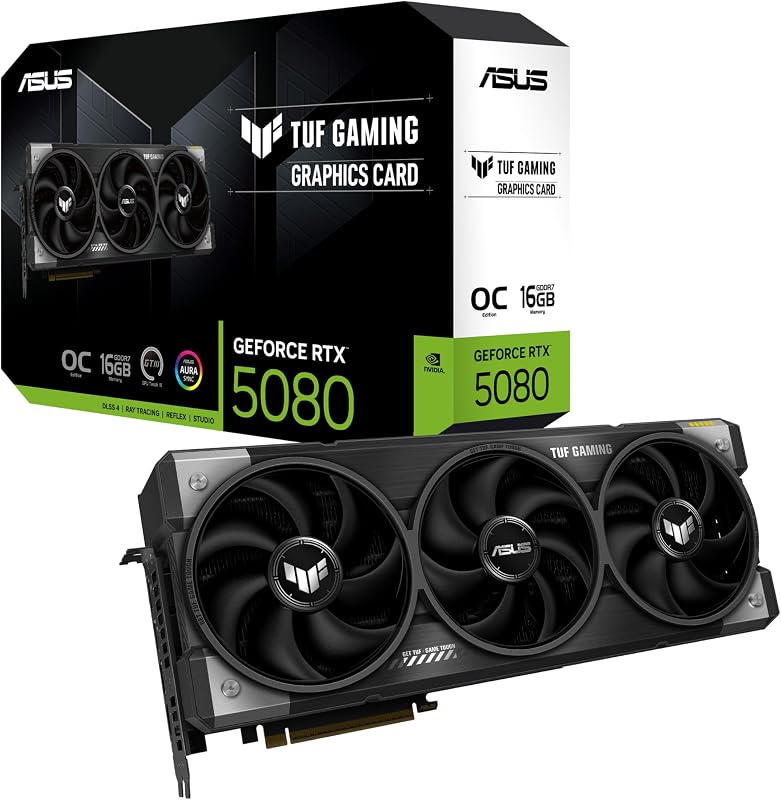
The PCIe 5.0 ASUS TUF Gaming GeForce RTX 5080 16GB GDDR7 OC Edition graphics card targets top-tier enthusiast setups. It boasts a massive 3.6-slot cooling profile, military-grade components, protective PCB coating, and Axial-tech fans. Enthusiasts who prioritize maximum graphics compute power, uncompromised 4K frame rates, and massive thermal headroom over chassis space efficiency should consider this high-end alternative.
ASRock Radeon RX 9070 Challenger

The ASRock Radeon RX 9070 Challenger provides an alternative path powered by AMD’s RDNA 4 architecture. It includes 16GB of GDDR6 memory across a wide 256-bit interface, a 2520 MHz boost clock, PCIe 5.0 support, an integrated LED indicator, and a triple-fan cooling system with 0dB silent fan modes. Buyers who prefer AMD architecture or want a wider memory bus width with triple-fan cooling will find this model worth considering.
Final Verdict
In evaluating whether this graphics card fits your build, the essential question is: is gigabyte 5060 ti 16gb worth it for modern gaming rigs? For builders targeting a reliable 1440p gaming setup, the combination of NVIDIA’s Blackwell architecture, high-speed GDDR7 memory, and DLSS 4 support offers a strong feature set. The standout benefit remains its 16GB memory capacity, which ensures that complex game worlds and detailed texture packs will not run out of memory space in the immediate future.
Furthermore, the WINDFORCE dual-fan design and 8.19-inch card length make it an easy upgrade for mainstream desktop systems where physical clearance is tight. While its 128-bit memory bus width remains a limiting factor compared to higher-end tiers, the 28000 MHz memory clock speed and architectural improvements help bridge the gap. For players seeking a balanced, modern, and compact graphics solution, this card stands out as a dependable choice.
FAQ
What are the primary Gigabyte RTX 5060 Ti 16GB specs?
The card features an NVIDIA RTX 5060 Ti coprocessor built on the Blackwell architecture, 16GB of GDDR7 memory operating at 28000 MHz across a 128-bit bus, a GPU boost clock of 2587 MHz, a PCIe 5.0 x16 interface, dual WINDFORCE fans, and DisplayPort and HDMI display outputs capable of up to 8K resolution.
How does GDDR7 memory improve this graphics card?
GDDR7 memory delivers significantly higher clock frequencies—running at 28000 MHz on this model—allowing for faster data transfer between the GPU core and video memory. This high-frequency throughput helps compensate for the 128-bit bus width, ensuring smooth asset streaming in demanding games.
Does the Gigabyte RTX 5060 Ti 16GB support DLSS 4?
Yes, the card is powered by the NVIDIA Blackwell architecture, which includes official support for DLSS 4. This technology leverages dedicated Tensor Cores to enhance frame rates and visual fidelity through AI-assisted upscaling and neural frame generation.
Will the Gigabyte RTX 5060 Ti WINDFORCE OC fit inside smaller PC cases?
Yes, the card measures 8.19 inches in length and 4.72 inches in width, utilizing a compact dual-fan design. This manageable size allows it to fit comfortably inside most standard mid-tower and smaller desktop computer enclosures without running into clearance issues.
What display connectors are available on this graphics card?
The card features DisplayPort and HDMI video output ports supporting up to 8K resolution. However, the manufacturer listing does not specify the exact revision versions (such as DisplayPort 1.4 or 2.1) for these connections.
How these reviews are put together
- 203reviews published
- 2,271products with a buyer rating
- 2,222products with listed features
- 87brands covered
Every number, star and price on this site is read from the Amazon product listing. We do not run lab tests of our own, so a score here is the average rating left by buyers, not a verdict from a test bench. Prices change without notice; check the listing before buying.


