ASRock AMD Radeon RX 9070 XT Challenger 16GB: Next-Gen 4K Gaming Examined
The ASRock RX 9070 XT Challenger brings AMD’s RDNA 4 architecture to performance-focused desktop gamers, pairing a high factory boost clock with a substantial 16GB GDDR6 memory buffer. Featuring 64 compute units alongside updated third-generation ray tracing and second-generation AI accelerators, this card targets enthusiasts who demand smooth frame rates in demanding modern titles without…
By Rachel Ford
8 min read
As Amazon Associates, we earn from qualifying purchases. This means we may receive a small commission at no extra cost to you if you click through and make a purchase.
The ASRock RX 9070 XT Challenger brings AMD’s RDNA 4 architecture to performance-focused desktop gamers, pairing a high factory boost clock with a substantial 16GB GDDR6 memory buffer. Featuring 64 compute units alongside updated third-generation ray tracing and second-generation AI accelerators, this card targets enthusiasts who demand smooth frame rates in demanding modern titles without sacrificing image fidelity. In our comprehensive asrock rx 9070 xt challenger review analysis, the card proves itself as a capable, well-engineered solution that balances high-clocked silicon with disciplined cooling hardware.
This graphics card suits PC gaming enthusiasts stepping up to high-refresh 1440p and native 4K gaming rigs who value future-ready display standards such as DisplayPort 2.1a and high-bandwidth PCIe 5.0 system integration. It is equally appropriate for creative users needing dedicated hardware acceleration for rendering and machine learning tasks. Conversely, builders planning compact mini-ITX enclosures or those running power supplies below the manufacturer’s 800W recommendation will need to look toward lower-tier or smaller form factor alternatives.
RDNA 4 Compute Architecture and 4K Gaming Performance
AMD’s RDNA 4 microarchitecture introduces structural enhancements designed to maximize graphics throughput, instruction scheduling, and per-clock efficiency. The ASRock Challenger leverages 64 unified compute units running at a boost clock reaching up to 2970 MHz, representing one of the highest factory clock rates in its class. In assessing real-world rx 9070 xt rdna 4 performance, the card delivers robust rasterization speeds across complex rendering engines, minimizing frame drops during intense combat and geometry-heavy outdoor scenes.
A major pillar of its gaming capability rests on the memory subsystem, where 16GB of GDDR6 memory interfaces across a 256-bit bus. Deploying the amd rx 9070 xt 16gb for 4k gaming provides the necessary headroom for uncompressed ultra-quality texture packs, high-resolution shadow maps, and expansive render targets that overwhelm 8GB and 12GB graphics cards. As discussed in our dedicated 9070 xt 16gb coverage, modern game releases increasingly demand more than 12GB of VRAM even at sub-4K resolutions, making a 16GB frame buffer a critical requirement for visual longevity.
The card also handles sustained render workloads with remarkable stability, avoiding performance degradation over long gaming sessions. By pairing refined cache hierarchies with high shader clock frequencies, the RDNA 4 architecture ensures that memory latency remains low even when streaming high-fidelity world assets in open-world titles. Gamers seeking dependable, stutter-free 4K rasterization will find the Challenger’s silicon configuration well-suited to the task.
Ray Tracing and AI Acceleration Capabilities
Ray-traced lighting has transitioned from an experimental feature to an essential visual standard in modern PC releases, and the ASRock Challenger incorporates AMD’s 3rd Gen ray tracing accelerators within each of its compute units. When evaluating rx 9070 xt ray tracing capabilities, the improved hardware traversal engines handle bounding volume hierarchy and ray-triangle intersection tests with substantially greater efficiency than earlier generations. This enables gamers to enable complex reflections, realistic shadows, and ambient occlusion while maintaining playable frame rates.
Working alongside the ray tracing hardware are 2nd Gen AI accelerators built directly into the compute units. These specialized matrix processing engines are designed to accelerate machine learning workloads, neural network inference, and intelligent image reconstruction algorithms. Offloading repetitive mathematical operations to dedicated AI silicon frees up primary shader pipelines, enabling superior computational throughput during demanding hybrid rendering passes.
Beyond entertainment, these AI accelerators provide valuable utility for content creators who rely on neural filters, video upscaling tools, and accelerated rendering in creative suites. The combination of third-generation ray tracing and second-generation AI acceleration creates a balanced foundation for cutting-edge game engines that rely heavily on hybrid rendering techniques.
ASRock Challenger Triple-Fan Cooling and Thermal Acoustics
Taming a high-frequency GPU boosting up to 2970 MHz requires a capable thermal solution, and ASRock implements a robust triple-fan design using Striped Axial Fan technology. The fan blades feature custom grooves on the surface and a smooth underside finish, designed to focus airflow directly downward through the dense aluminum heatsink fin stack. This focused airflow eliminates thermal dead spots over the core die, voltage regulation modules, and memory chips, ensuring stable temperatures under continuous load.
Acoustic performance is refined through 0dB silent cooling technology, which monitors GPU operating temperatures and halts all three fans during idle states, web browsing, and light office productivity. When gaming sessions begin, asrock rx 9070 xt thermals remain well-regulated as the fans engage progressively without abrupt speed changes. To further enhance thermal stability, a sturdy metal backplate spans the rear of the card, preventing PCB sag while assisting in heat dissipation through direct thermal contact with critical rear-mounted components.
While the thermal setup performs reliably, builders must plan their system power and case dimensions carefully. The manufacturer specifies an 800W power supply requirement to accommodate transient power demands under peak workloads. Although the listing does not specify exact card length in millimeters, housing a triple-fan cooler mandates a spacious mid-tower or full-tower PC case with unimpeded front intake airflow.
PCIe 5.0 Interface and Modern Display Connectivity
Modern gaming platforms demand high-speed bus connectivity, and this card features a native PCI Express 5.0 x16 interface. When installed in a PCIe 5.0 motherboard slot, the card benefits from doubled theoretical interconnect bandwidth compared to older PCIe 4.0 configurations, ensuring fast asset streaming between system RAM, high-speed NVMe storage drives, and the GPU frame buffer. Enthusiasts examining the core amd rx 9070 xt 16gb specs will appreciate that this interface maintains full backward compatibility with PCIe 4.0 and 3.0 motherboards while offering complete forward-looking bandwidth headroom.
Display connectivity is exceptionally modern, featuring three DisplayPort 2.1a ports alongside a single HDMI 2.1b connection. DisplayPort 2.1a provides the expansive bandwidth necessary to drive high-refresh-rate 4K displays and next-generation monitors without heavy display stream compression. With a maximum supported resolution of 7680 x 4320 pixels, this graphics card effortlessly supports single 8K displays or expansive multi-monitor productivity workstations.
This array of outputs makes the card especially attractive for simulation racers, flight simulator enthusiasts, and digital creators who run triple-monitor arrays at high resolutions. For a broader perspective on how AMD’s modern architecture scales across current hardware offerings, our detailed rx 9070 16 gb overview provides helpful comparative context across the wider product family.
ASRock RX 9070 XT Challenger Pros and Cons
Pros
- High 2970 MHz factory boost clock frequency
- 16GB GDDR6 memory across a 256-bit bus
- Modern PCIe 5.0 high-bandwidth interface
- Three DisplayPort 2.1a and HDMI 2.1b outputs
- Triple Striped Axial Fan system with 0dB silent mode
Cons
- Requires an 800W power supply
- Triple-fan cooler requires substantial chassis clearance
- Listing does not specify physical card dimensions
Check ASRock RX 9070 XT Challenger on Amazon
Who Should Buy the ASRock RX 9070 XT Challenger
Buy It If
- You want fluid native 4K and quad-HD gaming performance backed by 16GB of high-speed GDDR6 video memory.
- Your battle station features high-refresh monitors requiring modern DisplayPort 2.1a or HDMI 2.1b connections.
- You appreciate silent computing during daily office tasks and web browsing via 0dB fan-stop capabilities.
- Your system features a current motherboard capable of leveraging high-bandwidth PCIe 5.0 expansion slots.
Skip It If
- You are assembling an ultra-compact small form factor build that cannot accommodate a full-length triple-fan cooler.
- Your existing desktop power supply is rated below the manufacturer’s recommended 800W specification.
- You require enterprise-grade memory capacities exceeding 16GB for heavy workstation modeling tasks.
ASRock RX 9070 XT Challenger Alternatives Worth a Look
Before making a final component selection, reviewing contemporary alternatives from different design approaches helps clarify which card best suits your chassis, power supply, and memory requirements.
ASUS SFF-Ready Prime RTX 5070

The ASUS SFF-Ready Prime NVIDIA GeForce card targets builders working within compact chassis constraints, utilizing a 2.5-slot footprint, Axial-tech fans, and dual BIOS functionality. In evaluating the amd rx 9070 xt vs rtx 5070 comparison, the ASUS model features 12GB of newer GDDR7 memory. Builders with compact cases or a preference for NVIDIA’s software ecosystem may lean toward this option, though it provides 4GB less total VRAM than the Challenger.
ASUS TUF Gaming RTX 5080
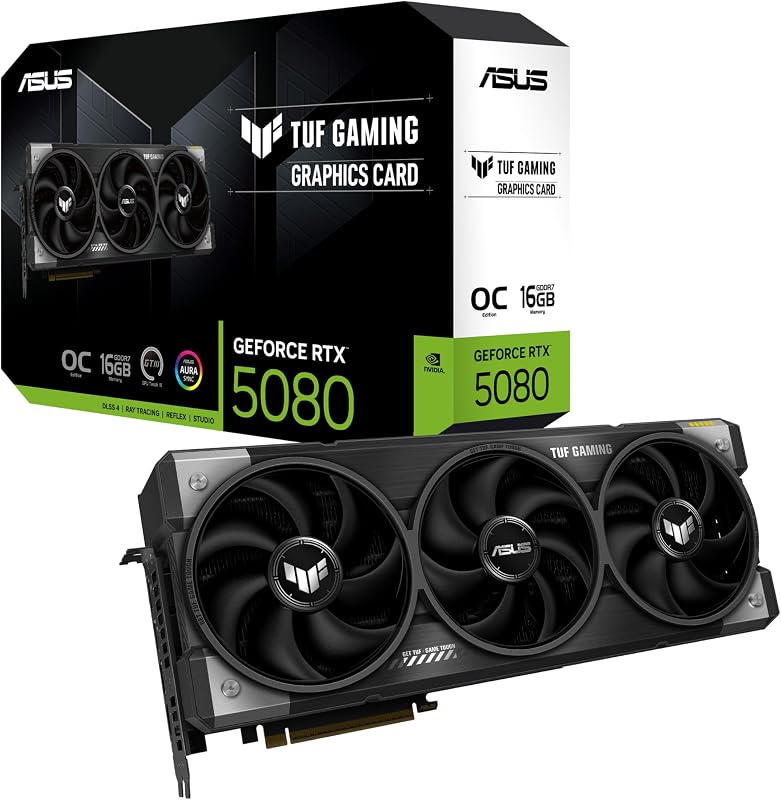
For builders seeking heavy-duty cooling construction, the PCIe 5.0 ASUS TUF Gaming GeForce RTX 5080 OC Edition features a massive 3.6-slot cooler, military-grade components, and a protective PCB coating. Equipped with 16GB of high-speed GDDR7 memory and Axial-tech cooling fans, it suits enthusiasts who have substantial case volume and want a top-tier enthusiast GPU.
GIGABYTE RTX 5080 Gaming OC
The GIGABYTE GeForce RTX 5080 Gaming OC utilizes a triple-fan WINDFORCE cooling system combined with 16GB of 256-bit GDDR7 memory. Gamers seeking higher raw memory bandwidth through the newer GDDR7 standard will find this card appealing if their build allocation accommodates stepping up to a higher GPU class.

Final Verdict
When asking is amd rx 9070 xt worth it for enthusiast PC gaming, the ASRock Challenger presents a compelling argument. Built around 64 RDNA 4 compute units, an impressive 2970 MHz boost clock, and a generous 16GB GDDR6 memory buffer, it delivers the horsepower needed to conquer modern 4K titles. The inclusion of three DisplayPort 2.1a ports, HDMI 2.1b, and PCIe 5.0 support ensures that your investment remains relevant as monitor technologies and platform standards advance.
Thermal execution is equally dependable, backed by Striped Axial fans that keep thermals in check under sustained gaming loads while offering complete silence during casual desktop use. For gamers who prioritize raw rasterization muscle, future-proof memory capacity, and disciplined acoustics over unnecessary visual frills, this card serves as an excellent upgrade. If you wish to examine alternative partner implementations of the same silicon, check out our sapphire nitro radeon rx 9070 xt breakdown.
FAQ
What power supply is recommended for the ASRock RX 9070 XT Challenger?
The manufacturer listing specifies an 800W power supply requirement to ensure system stability under heavy computing and high-frequency gaming loads.
Does this graphics card support hardware ray tracing?
Yes, the card incorporates AMD’s 3rd Gen ray tracing accelerators within its 64 RDNA 4 compute units, accelerating real-time lighting calculations, dynamic reflections, and ambient shadows.
What display outputs are available on the ASRock Challenger?
The card features three DisplayPort 2.1a ports and one HDMI 2.1b port, supporting multi-monitor configurations and single displays up to an 8K resolution of 7680 x 4320 pixels.
How does the 0dB silent cooling mode operate?
The 0dB silent cooling technology halts all three Striped Axial fans completely during low-temperature, light-load scenarios such as web browsing or document editing, delivering noiseless operation.
How much video memory is installed on the card?
It comes equipped with 16GB of dedicated GDDR6 memory operating across a 256-bit bus, providing ample bandwidth for high-resolution 4K gaming textures and content creation workflows.
What accessories are included in the packaging?
According to the product specifications, the package includes one graphics card and one quick installation guide.
How these reviews are put together
- 203reviews published
- 2,271products with a buyer rating
- 2,222products with listed features
- 87brands covered
Every number, star and price on this site is read from the Amazon product listing. We do not run lab tests of our own, so a score here is the average rating left by buyers, not a verdict from a test bench. Prices change without notice; check the listing before buying.


